DinosaurTheory Introduction
Solution to the Puzzle
We begin our explanation of how dinosaurs and pterosaurs grew so large by reviewing a basic principle of physics: mass and weight are not the same thing. The mass of an object remains constant regardless of location, whereas weight is the product of mass and gravitational field strength.
If we excuse the mixing of metric and English units, a fairly large person with a mass of 100 kg weighs about 220 pounds (1,000 N) on Earth. If that same person could somehow stand on the surface of the Moon without a spacesuit, their mass would still be 100 kg, but because of the Moon’s weaker gravitational field, they would weigh only about 36 pounds (162 N).
When astronauts were on the Moon, they hopped about because they felt so light on their feet. This occurred because the Moon’s surface gravity is only about one-sixth that of Earth. If humans were to establish a permanent colony on the Moon and live there for thousands of years, future generations would likely evolve to be much larger than people on Earth. Eventually, such Moon-adapted humans would be unable to return to Earth because they would weigh too much to stand or walk in Earth’s stronger gravitational field.

Beam me up Scotty, there is no intelligent life on this planet.
In science-fiction films and television shows, space travelers cross the galaxy and land on distant planets where gravity is conveniently identical to Earth’s. In reality, this is unlikely, since there is usually considerable variation in the size of planets and moons. On larger planets, travelers would feel much heavier and struggle to move. On smaller planets or moons, they would feel extremely light and leap about with ease. They would also observe that animals on the larger planets – the strong-gravity worlds - tend to be smaller, while animals on weak-gravity worlds tend to be much larger. Although such creatures would appear either tiny or monstrous to us, their size would be completely normal for their environment.
Now consider how this applies to the enormous terrestrial animals of the Mesozoic era. The exceptional size of dinosaurs, pterosaurs, and birds suggests that these animals lived in an environment with a much weaker effective gravity than exists on Earth today.
How could this be possible? Some have proposed far-fetched ideas involving changes in Earth’s mass or the gravitational constant. However, it is not necessary to invoke such extremes to explain how effective weight could be reduced. We start by recognizing that even on Earth today, the weight we measure is not due to gravity alone.
When we step on a bathroom scale, the weight we measure is slightly less than the force due solely to gravity. This is because two additional forces act in opposition to gravity: the centrifugal force from Earth’s rotation and the buoyant force from Earth’s atmosphere. Together, these make us feel about one pound lighter.
The centrifugal force arises from Earth’s rotation and represents a weak tendency to fling objects away from the surface. It is given by:
where Fc is the centrifugal force, m is mass, r is distance from the axis of rotation, and ω is Earth’s angular velocity. The faster Earth spins, the greater this force becomes.
While Earth was rotating rather quickly when it first formed, its rotational speed has been slowing down ever since. During the Mesozoic era - billions of years after Earth first formed - its rotational speed had slowed considerably, yet it was still spinning faster than it does today. Thus, during the age of the dinosaurs, centrifugal force was slightly stronger than it is now. Even so, this centrifugal force remained small compared to gravitational force and would have had little effect on reducing the weight of the dinosaurs.
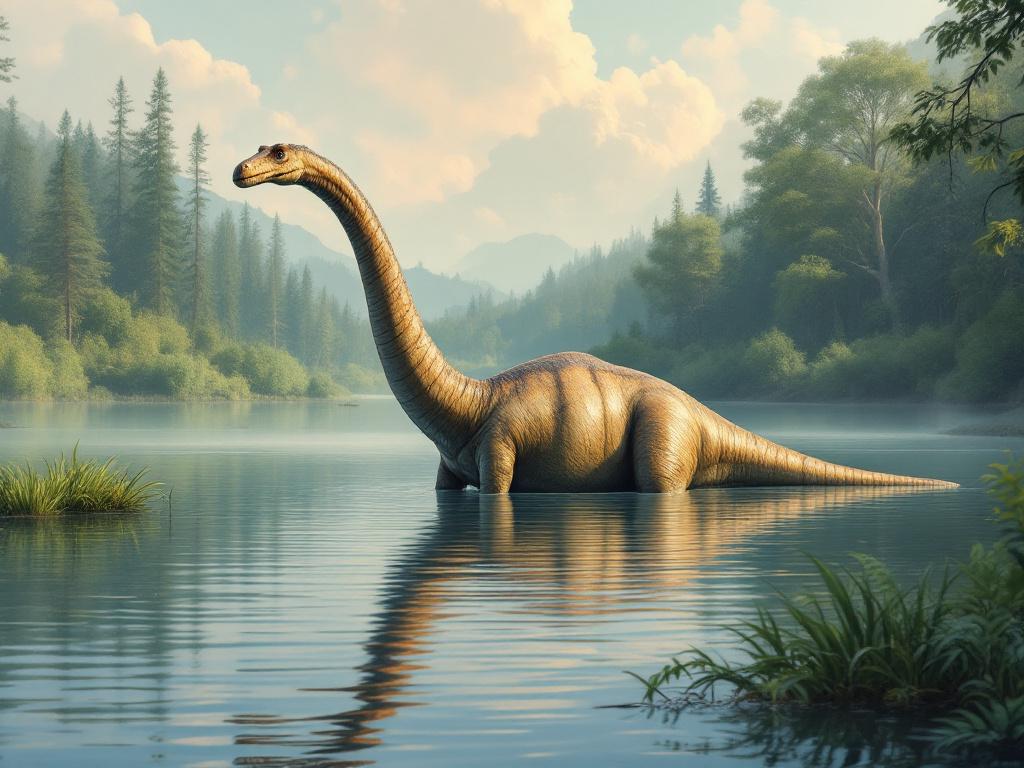
Paleontologists originally hypothesized that the largest dinosaurs - such as Brontosaurus - spent most of their time soaking in rivers or lakes as an explanation for how these animals were able to support their weight.
The buoyancy force provides a more promising explanation.
Today, the largest animals on Earth are whales. They grow large because water provides an upward buoyant force that counteracts gravity. Early paleontologists recognized how the buoyancy of water reduces the effective weight of animals and suggested that the largest dinosaurs – the sauropods - spent much of their time wading in lakes or rivers. However, this idea was later abandoned when fossil trackways and bone structure showed these animals to be truly terrestrial.
After discarding the water hypothesis, paleontologists proposed that the large size of Mesozoic animals could be explained by claiming that these animals were somehow stronger, lighter, or biologically superior to modern terrestrial animals. Paleontologists assert that dinosaurs’ bones, muscles, and hearts were far stronger and more efficient than those of modern animals. Similarly, to explain the existence of large flying pterosaurs, paleontologists claimed that these creatures were incredibly light and faced no difficulties in flying - despite aerodynamic calculations and experiments with radio-controlled models indicating otherwise.
Many physicists, biologists, engineers, and other scientists outside paleontology find these explanations unconvincing. From an evolutionary perspective, the idea that nature once possessed biological adaptations allowing for extreme size - only to lose them over time - raises serious questions. These claims, made by the paleontologists, do not appear to be grounded in established theories in biology or known laws of physics.
Public skepticism of these “super-dinosaur” proposals is why many non-scientists have taken matters into their own hands by offering their own flawed attempts to solve the paradoxes of the Mesozoic era. While paleontologists typically ignore these alternative hypotheses, they were clearly infuriated when biologist Brian J. Ford revived the water buoyancy hypothesis - an action that gave voice to the public’s skepticism.
Nevertheless, neither the alternative hypotheses, which violate the laws of nature, nor Ford’s revived buoyancy hypothesis brings us any closer to resolving the paradoxes. The proposal that dinosaurs spent their days soaking in water suffers from the same flaws as before: when dinosaurs left the water, their bodies should have been sluggish like crocodiles, yet fossil trackways show otherwise. On the other hand, if dinosaurs had lived permanently in water, evolutionary pressure would have caused them to lose their legs, just as occurred in the evolution of whales.
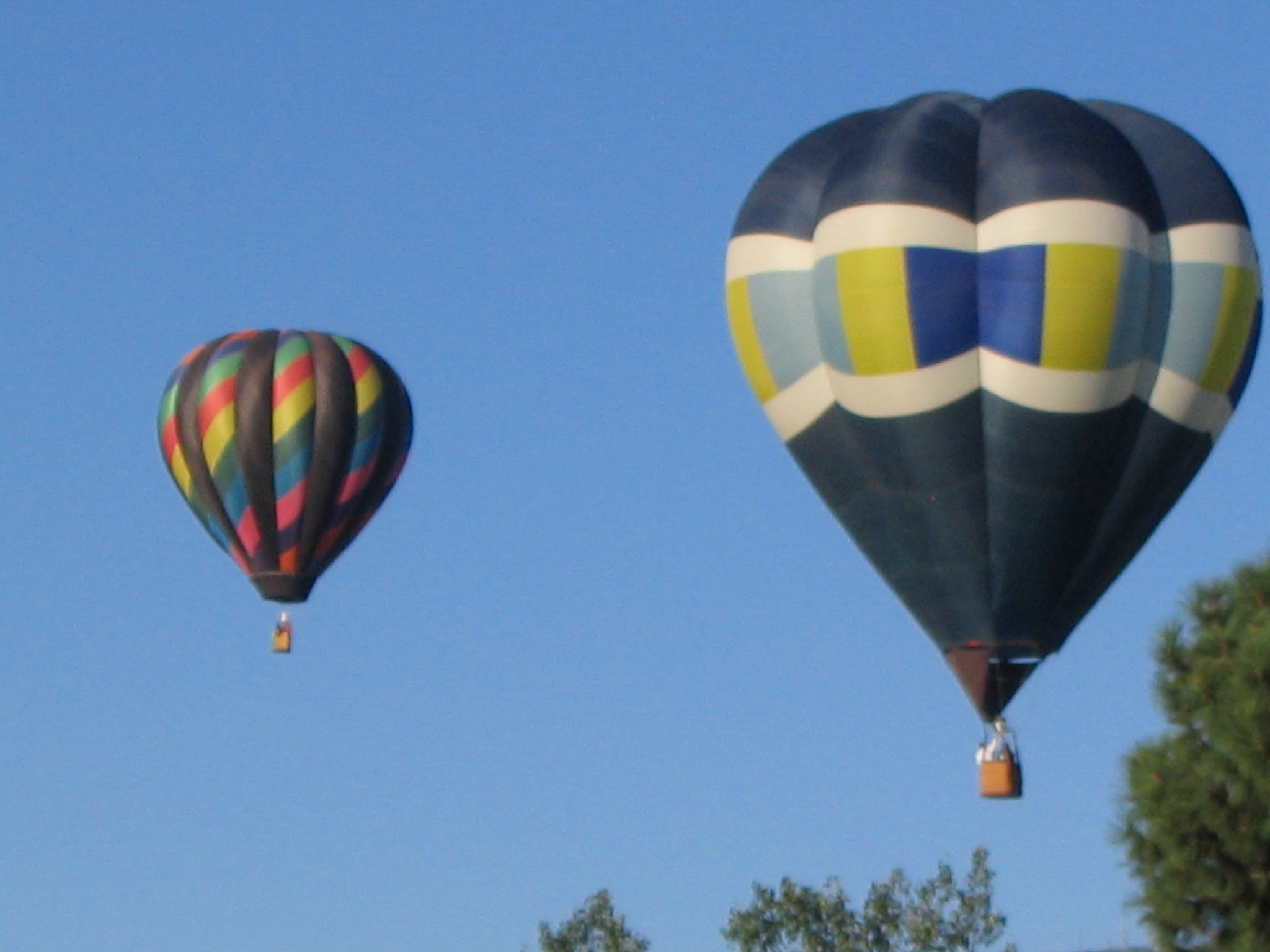
The hot air inside the balloon has a lower density than the surrounding air. Gravity multiplied by this density difference and by the volume of the balloon produces the buoyant force that lifts the balloon.
For buoyancy to reduce dinosaur weight without eliminating locomotion, dinosaurs would have needed to be immersed in a fluid less dense than their bodies.
Air is a fluid with a much lower density than the bodies of most animals. However, because of air’s comparatively low density, we typically do not think of it as capable of providing significant buoyancy unless a device contains a large volume of air - such as a hot-air or gas balloon. Near Earth’s surface, air is about a thousand times less dense than water, and water is about the same density as the bodies of most vertebrates. The only way air could have provided enough buoyancy to significantly reduce the effective weight of terrestrial animals - thus enabling them to grow much larger - is if the atmosphere was hundreds of times thicker than it is today.
For many people, it is inconceivable that Earth’s atmosphere could have been hundreds of times thicker than it is today. As much as they expect the Sun to rise each morning, the atmosphere appears the same day after day. Our present atmosphere is all that we have ever known, and from this consistency, people get the impression that the atmosphere is as unchanging as the Earth itself. Who would have thought that Earth’s atmosphere could have been hundreds of times denser than it is today? Until recently, apparently no one. And yet, had they considered this possibility, they would have found the solution to numerous scientific paradoxes.
Contrary to the common assumption that there is a standard thickness assigned to Earth’s atmosphere, there is no inherent limitation on the thickness of a planet’s atmosphere, aside from the amount of gas available to form it. If we were extraterrestrial visitors arriving in our solar system for the first time, then, based on the fact that Earth is larger and more geologically active than the other terrestrial planets, our initial expectation would be for Earth, rather than Venus, to be the terrestrial planet with the thickest atmosphere.

If not for water on Earth's surface and the evolution of life on Earth, Earth's atmosphere would be similar to Venus' atmosphere.
Consider how unique Earth’s atmosphere is today. While Earth’s atmosphere is currently 78% nitrogen, 21% oxygen, and 1% argon, in addition to trace amounts of carbon dioxide and other gases, this composition does not match that of other planets. In contrast to Earth, the other terrestrial planets with atmospheres - Venus and Mars - have nearly identical compositions of about 96% carbon dioxide and 3% nitrogen. It is a mystery why Earth is so different until we realize that, to transition from the standard atmosphere of a terrestrial planet to Earth’s present atmosphere, all we have to do is remove nearly all of the carbon dioxide and add oxygen.

Limestone shell fossils and modern sea shells in front of a Holly plant: Plants remove carbon dioxide while releasing oxygen into the atmosphere. Sea life removes even more carbon dioxide by forming shells that accumulate as vast limestone sedimentary rock deposits. Over millions of years, these processes have dramatically altered the composition and thickness of Earth’s atmosphere.
And why would this dramatic transformation occur on Earth and not on these other planets? Because, unlike these other planets, life evolved and thrived on Earth. For billions of years, plant life has been removing carbon dioxide from the atmosphere while releasing oxygen. For even faster carbon dioxide removal, marine animals have spent the last several hundred million years using carbon dioxide to create their shells, which then accumulate on the seafloor. In addition to the shells of marine animals forming limestone, it appears that bacteria played a role in creating dolomite, and together these layers of carbonate sedimentary rock make up a whopping 20% of all sedimentary rock on Earth.
Doing the math, we might initially conclude that, if not for life evolving on Earth, Earth would have ended up with an atmosphere about thirty times thicker than it is today. However, in addition to taking in carbon dioxide, plants also require nitrogen - think fertilizer - thus indicating that the reduction in atmospheric thickness is far greater than what is implied by the graph. All evidence considered, Earth’s atmosphere would now be a couple thousand times thicker if not for life evolving on Earth. The reason Earth’s present atmosphere is thinner rather than thicker than Venus’s is because life evolved on Earth.
The explanatory power of this idea is difficult to ignore. It not only accounts for the uniqueness of Earth’s atmosphere but does so in a direct and coherent way. In hindsight, it raises an obvious question: how was this overlooked?
The strength of the thick-atmosphere solution lies in its simplicity - an excellent example of Occam’s Razor in action. And yet there is more: the thick-atmosphere solution explains all of the scientific paradoxes listed on the previous page. The solution to these numerous paradoxes could hardly be more clear, straightforward, and rational.
1. The Large Dinosaurs’ Paradox: How did terrestrial animals of the Mesozoic era grow to be over three times larger than modern terrestrial animals?
The several-hundred-times-denser Mesozoic atmosphere provided an upward force – buoyancy - that effectively reduced the weight of dinosaurs and other terrestrial animals. The overall size of terrestrial animals is determined by the effective gravity of a planet or environment. Since dinosaurs grew to be about three times larger, this implies that atmospheric buoyancy reduced the effective gravity to about one-third of its present value.
2. The Tall Dinosaurs’ Blood Pressure Paradox: How was it possible for the tallest dinosaurs of the Mesozoic era to pump blood to heads over three times higher than those of giraffes?
The buoyancy provided by a thick atmosphere reduced weight uniformly throughout the body. Thus, the blood in a tall dinosaur’s neck arteries weigh only about one-third as much. With the same pressure, the heart was capable of raising blood to approximately three times the height.
3. The Unique Shape of Dinosaurs: Given that form follows function, how did the large rear legs and muscular tails of dinosaurs enhance their survival?

Dinosaurs were not just wagging their tails. Most dinosaurs were using their strong, muscular tails - along with their large, muscular rear legs - to quickly propel themselves forward through the extremely dense atmosphere.
While buoyancy enabled dinosaurs to grow three times larger, this would require an atmosphere with a density approaching a significant fraction of water. Movement through such a dense fluid would create substantial resistance, shifting much of the load to the rear legs and reducing the functional role of the forelimbs during locomotion - hence stronger rear legs. Furthermore, in such dense air, a muscular tail could provide forward propulsion, similar to how an alligator’s tail functions in water.
4. The Giant Flying Pterosaurs Paradox: How did pterosaurs become the largest flying reptiles when no reptile alive today is capable of powered flight?
Flight equations (see Chapter 3) show that increased fluid density reduces the power required for flight and lowers the speed needed for takeoff and landing. With an atmosphere approaching a significant fraction of water’s density, pterosaur flight may have been more analogous to the motion of rays swimming through water.
5. The Giant Flying Mesozoic Birds Paradox: How was flight so accessible during the Mesozoic that birds with relatively small wings could grow to be three times larger than the largest flying birds today?
As with pterosaurs, the much denser atmosphere made flight significantly easier - providing greater lift while requiring less power. This enabled birds to grow much larger than modern flying birds. Because paleontologists have assumed that the Mesozoic atmosphere was as thin as it is today, they could not imagine these large birds as being capable of flight, and so they misidentified several of them as dinosaurs, despite the fact that these birds show fully developed wings and asymmetric flight feathers.
6. The Seemingly Impossible Mesozoic Climate: How was it possible for Earth to have no ice at either pole without being significantly warmer overall?
In contrast to our current three-cells-per-hemisphere atmosphere, it is far more likely that the much thicker Mesozoic atmosphere had a single large convection cell in each hemisphere - similar to present-day Venus. Such a circulation pattern explains the much greater efficiency in transporting heat from the equator to the polar regions during the Mesozoic era.
While these are the strongest arguments, there are actually countless more evidence-base arguments supporting the position that previously the Earth had a much thicker atmosphere. Whether one accepts the thick-atmosphere hypothesis or attempts to disprove it, investigation consistently reveals evidence in its favor. The more closely the issue is examined, the more difficult it becomes to deny that the Mesozoic atmosphere was hundreds of times denser than today’s. The success of this framework indicates that the Thick Atmosphere Theory is more than a hypothesis - it is a unifying scientific theory.
Naturally, many people are delighted that a clearly rational explanation has been found that resolves these numerous long-standing scientific paradoxes. Yet others struggle with the realization that many accepted scientific claims are in fact, not correct. After being told repeatedly that massive dinosaurs are not a paradox, that giant flying pterosaurs present no real difficulty, and that birds are dinosaurs, it is not easy to reconsider these conclusions. In a state of disbelief, there are those who asks: How could so many scientists be wrong?
Indeed, how could so many scientists be wrong? Before addressing this question, it should be noted that not all scientists were mistaken.
Misleading Authorities
Instead of engaging in sincere debate regarding the possibility that Earth previously had a much thicker atmosphere, conservative scientists are spreading disinformation for the purpose of confusing the public. In one case, they intentionally misinterpret gas bubbles as raindrop impressions and then make the dubious claim that this can be used to determine atmospheric thickness. In another case, they make the highly questionable claim that tiny bubbles in amber have faithfully sealed atmospheric air for billions of years, and that scientists can somehow extract and analyze these tiny bubbles without contaminating the results.
With these conservative scientists dominating the messaging in the media, AI makes the false claim that these gas bubbles prove that the Mesozoic atmosphere could not have been thicker than the present atmosphere. In addition to the other problems mentioned, AI (or is it the conservative scientists) fails to realize that their 2.7 to 2.3 billion-year-old bubbles miss the Mesozoic era by over two billion years.
This is just another example of how conservative scientists hold back the advancement of science. On the one hand, they censor the discussion of evidence that calls into question the validity of their beliefs; on the other hand, they promote scientifically flawed bullshit to confuse the public to avoid admitting that they are wrong.
- While some “researchers” curry favor with their peers by offering unrealistically low estimates for the largest dinosaurs - 23 tons or even less for Brachiosaurus - thereby sidestepping the difficulty of explaining how a terrestrial animal could be so massive, paleontologist Chris McGowan deserves recognition for providing an evidence-based estimate of 78 tons, along with frank discussion of this and other problems associated with the giant animals of the Mesozoic era.
- Using tiny sensory and tracking devices, researcher Katsufumi Sato of the University of Tokyo’s Ocean Research Institute has gathered considerable data on the flight of birds. His research indicates that about 40 kg is the upper limit for a bird to achieve powered flight. When applied to ancient flyers such as Quetzalcoatlus and Pteranodon, this suggests that something unknown is in play that gave these animals the ability to fly. Paleontologists have mostly ignored these conclusions rather than acknowledge the challenge that they make to their beliefs.
- When expert paleobiologist Alan Feduccia, along with zoologist Devon Quick and vertebrate paleobiologist John Ruben, presented evidence arguing that birds could not have evolved from theropod dinosaurs, it should have given pause to those claiming otherwise. But it did not. Paleontologists have been unable to explain how the largest birds of the Mesozoic era could fly, and to address this difficulty, much of the paleontological community has promoted the highly questionable interpretation that these animals were non-flying dinosaurs.
- Countless geologists and planetary scientists - Richard G. Prinn, Heinrich D. Holland, James F. Kasting, D. M. Hunten, V. I. Moroz, L. M. Mukhin, S. I. Rasool, C. de Bergh, A. B. Ronov, Hiroshi Ohmoto, and many others - have argued that early Earth may have had a much thicker CO₂-rich atmosphere, possibly comparable to or exceeding that of present-day Venus. This conclusion is based on volcanic outgassing, carbonate sedimentary deposits, and comparisons with the atmospheres of Venus and Mars. The possibility that Earth once had a much thicker carbon dioxide atmosphere follows logically from this evidence, yet it conflicts with claims that relatively small increases in atmospheric CO₂ would necessarily produce runaway warming.
- The climate science community initially expected leading climatologist Judith Curry to support prevailing interpretations of how carbon dioxide influences global temperature. However, following the Climatic Research Unit email controversy (“Climategate”), she raised concerns about the extent to which political considerations were influencing the field. Unlike many of her colleagues, she did not extrapolate beyond the data to support more alarmist conclusions, resulting in others in her field referring to her as being a traitor. Eventually she resigned her lead position at the Georgia Institute of Technology rather than put up with the harassment.
- Octave Levenspiel was one of the first to suggest that a thicker atmosphere might explain how dinosaurs and pterosaurs were able to grow so large. However, being a chemist rather than a physicist, he proposed that the atmosphere was only three to five times thicker, rather than recognizing that it would need to be hundreds of times thicker to have a significant effect. He also failed to provide an explanation for how or why the atmospheric thickness would change. Nevertheless, his proposal did point science in the right direction; his work was rejected fourteen times before being published in a chemistry journal.
Thus, we see that there were numerous scientists working in various fields who presented evidence that collectively leads to the conclusion that the atmosphere was much thicker during the Mesozoic era. And yet their work was either censored, marginalized, or ignored because it did not align with the more popular prevailing views.
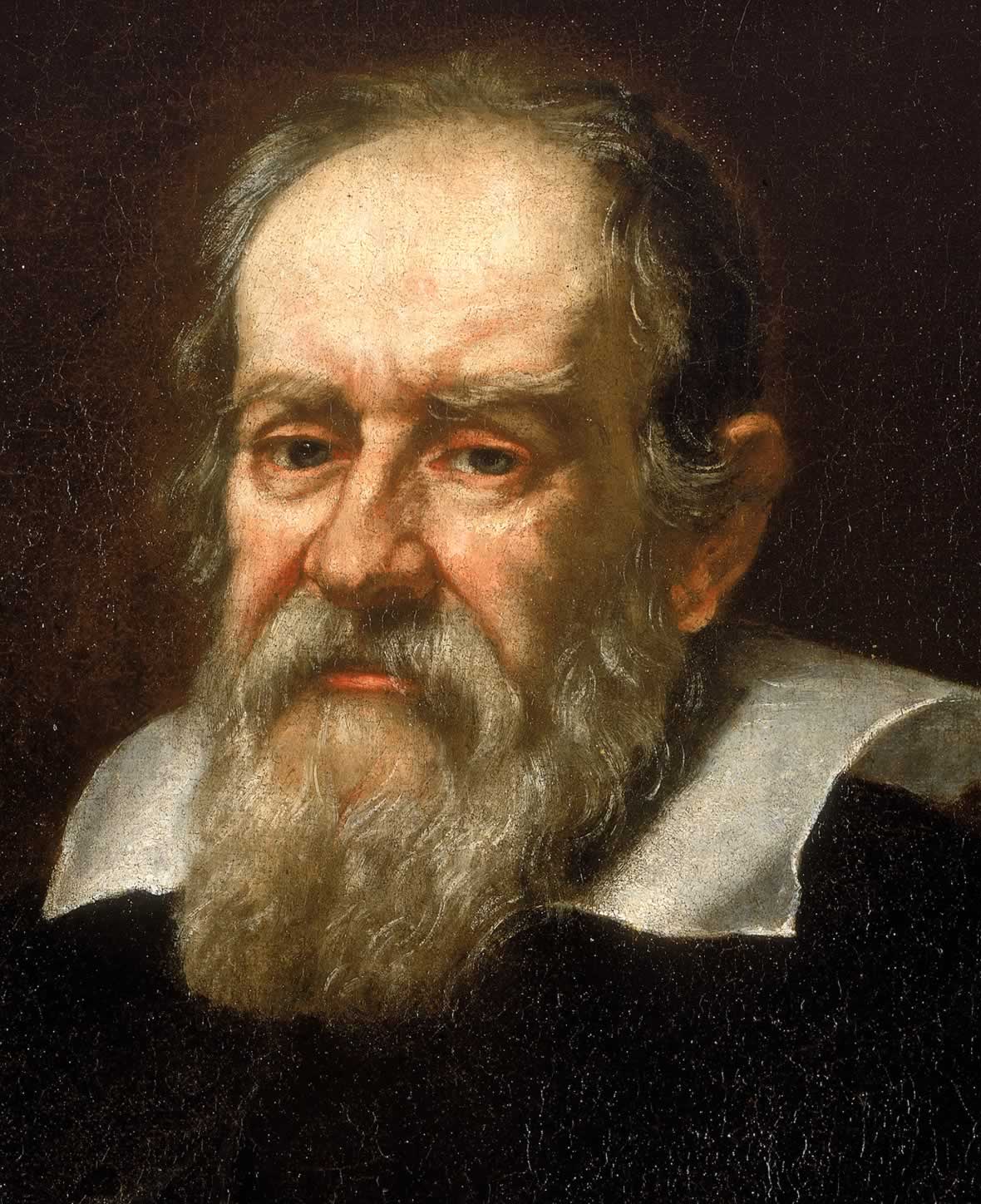
For centuries, science educators have been hampered in their efforts to teach Galileo’s explanation of how size matters because paleontologists make the false claim that there is nothing unusual about Mesozoic-era dinosaurs, pterosaurs, and flying birds being so incredibly large.
In science, evidence determines what is right or wrong, yet scientists interpret that evidence. Sadly, conservative scientists can be relentless in misinterpreting evidence to avoid admitting they are wrong. This refusal to concede error is precisely what Max Planck referred to when he said that science advances one funeral at a time.
Conservative scientists have no justification for censoring the ideas presented in DinosaurTheory, yet they do so to avoid exposing their errors. They know that this ‘controversy’ would be resolved immediately - and not in their favor - if open discussion were allowed. In contrast to their claim of being leading scientists, no group of people does more to hinder scientific progress than these conservative scientists.
In describing major breakthroughs, science education focuses on how advances improve our understanding of reality, yet textbooks rarely address what delayed their acceptance. They seldom note that, when correct ideas emerge, conservative scientists often delay acceptance for decades, centuries, or even indefinitely. While we celebrate revolutionary ideas that eventually break through, there are no guarantees as to when - or if - important scientific insights will be recognized.
Despite the overwhelming evidence supporting the Thick Atmosphere Theory, its fate remains uncertain. This is an age of confusion, where weak reading and reasoning skills make it easy for misleading authorities to shape public opinion. Sound reasoning and evidence - the foundation of science - have lost significance as conservative scientists have steered science education towards teaching students what to think rather than how to think.
Nevertheless, DinosaurTheory is written for whatever intelligent life might still exist on this planet. It is one of the last remaining candles of enlightenment in the darkness of human ignorance; let us hope that it does not get blown out.
DinosaurTheory begins with an introduction to Galileo’s Square-Cube Law: an important scientific concept that clarifies how size matters. For centuries, conservative scientists have ignored Galileo’s work for the same reason they now censor DinosaurTheory: it brings clarity to the fact that these conservative scientists are wrong.
David Esker
M.S. Physics
College Physics Instructor
Resolution of the Large Dinosaur Paradox
Science of Flight Equations
Theory of Planetary Evolution
Author of DinosaurTheory
Science is an ongoing process of discovery. We do not know why our reality exists; we struggle to define what life is; we do not know how the laws of physics came to be or why the physical constants have the values they do. Yet one thing is undeniable: science advances on the assumption that our reality is rational.

Comments, Questions, and Answers
Selected comments and questions are given with the permission of the parties involved.
David,
When I first found your book you had the last few chapters available for sale. My only question is could I purchase the unfinished version?
You have answered the questions I had about square / cubed Law and tied together so much of the fossil record for me.
You have given me confidence when my sons ask me about paleontology and dinosaurs to share your concepts as a possible way these massive creatures could have operated.
You even touch on the 6 foot dragonfly…I could go on.
Your theory provides explanations for phenomena that I had only heard psuedo-science from cheesy Creation scientists and their water canopy or floating sheet of ice theory.
In contrast, your work is succinct, accessible but completely based on science and not fanciful presupposition.
I am a big proponent of your work. I tell anyone in my immediate circle that they need to read what you have available. Personally, I think your theory could have a profound effect on chronology and dating. Certain methods presupposed certain amounts of carbons and atmospherical gases / conditions.
Your thick atmosphere theory, if integrated into dating models could throw the chronologies on their heads. The implications of that potential are very satisfactory to contemplate.
Thank you again for your work.
I feel it is unfortunate that others minds are resistant to the concepts and theories you express.
For me, you answered questions that I had been asking for 10 years+ I am honored by your response,
To Your Success!
Jesse
Please send an e-mail if you have questions or comments

Hello Mr. Esker,
I recently found your website while researching the dinosaur paradox. Luckily, yours was among the first I stumbled upon; it's clear, concise, &, as a result, convincing presentation of your atmospheric solution is much appreciated. My previous, cursory research into the paradox turned up a convoluted mention of an atmospheric element at play, but your in depth analysis ensures that little question remains in my mind on the matter.
I'd simply like to, as the subject stated, thank you, & say: well done. I wish you luck in both current & future pursuits.
Cheers,
Trevor
Gettysburg College