| Previous Chapter | Home Page | Next Chapter |
8. Hell, Heaven and Earth: Part 2 - Heaven: Evolution of our Solar System
Theory of Planetary Evolution

Independent civilizations all over the world built astronomy observatories comparable to Stonehenge - proof of humanity’s universal fascination with the heavens.
The wonder of the distant objects in the sky has always been an uplifting spiritual blend of science and religion. Astronomy is the eternal quest to make sense of everything in the sky that lies beyond the clouds.
The most distinguished feature of the heavenly bodies is their regularity. Every morning the Sun comes up, once a month the Moon goes through its phases, and once a year the patterns of stars cycle through their night-time display. As witness by the numerous early observatories that marked the regularity of these events, one could claim that science and indeed civilization began with astronomy. By first recognizing the orderly events in the sky, mankind has slowly come to realized that we exist in a rational universe.
Science is based on the belief that our reality is rational, and following this belief has proved to be a remarkably successful strategy. This is not to say that everything we currently know about reality makes sense to us, but rather that the belief that our reality should make sense is an approach that can be extremely helpful in our efforts to discover the workings of the universe. In the case of astronomy, this is the difference between simply recording observations about stars and planets and attempting to figure out the logical reasons explaining these objects.
In contrast to science, religion is based on faith and so it does not require physical evidence to support its beliefs. Without the requirement of supporting evidence, popularity becomes the most important criteria for a religion to be successful. Religions achieve their popularity by promoting beliefs that make people feel special.

Radio telescope, possibly listening for signs of intelligent alien life. Are we alone? Even within our own solar system, primitive life may exist. With billions of solar systems in the Milky Way alone — and billions of galaxies beyond — it is extremely likely that advanced life is scattered throughout the universe.
For mankind to thrive as rational beings, a strong distinction must be made between science and religion. Scientists should align themselves with beliefs that are best supported by evidence, rather than those that gain popularity simply because they make us feel good. In science education, lessons should include practicing the application of evidence-based reasoning for the purpose of drawing logical conclusions. Whenever a new scientific belief is introduced, teachers should lead a discussion of the evidence supporting it; merely stating that a belief is the consensus of experts is completely unacceptable. Science distinguishes itself from religion by encouraging people to develop their reasoning skills and focusing on evidence, rather than accepting beliefs as a matter of faith.
While the vast majority of scientific beliefs are true, history shows that leading scientists often initially cling to incorrect beliefs before eventually accepting the truth. Therefore, until there is considerable evidence supporting a belief - such as in the case of the Theory of Evolution - caution is needed in determining what is actually true. Pay attention to the strength of evidence-based arguments rather than how often a claim is repeated. A major red flag indicating that a popular belief is likely wrong is when scientists argue that their belief must be true simply because it is their consensus that it is true; in real science, the popularity of a belief cannot be used as a substitute for the presentation of clear evidence-based arguments in support of a belief.
Astronomers face a greater challenge than most other scientific disciplines in sorting through false beliefs on their way to discovering the truth. This is because, unlike other fields, in astronomy it is rarely possible to run experiments to test hypotheses. While leading scientists are usually extremely stubborn about abandoning incorrect beliefs, this inability to test hypotheses makes it even more difficult to discard bad ideas.
In the previous chapter, we learned that tidal forces - caused by the stretching of the Earth - explains why Earth’s interior is so warm. This new insight raises the question: does tidal heating also apply to other major objects in our solar system? Indeed, there is universal agreement among planetary scientists that tidal heating is the mechanism warming the interior of Jupiter’s moon Io. Furthermore, besides Io, astronomers have identified several other moons of Jupiter and Saturn where tidal heating plays a significant role in heating their interiors. Yet, astronomers still cling to the incorrect belief that radioactivity explains the internal heating of most planets and moons, including Earth. This is just another example of stubborn scientists refusing to yield to the evidence indicating that their belief is wrong.
This chapter will demonstrate how tidal heating can explain the evolutionary development of all the planets and moons in our solar system. In contrast to the radioactivity heating hypothesis, tidal heating has universal predictive power that matches observations throughout the solar system. It is the key component of the Theory of Planetary Evolution - a theory that greatly advances our understanding of the solar system
The Theory of Planetary Evolution, along with the laws of nature, gives us guidance towards understanding how the planets of our solar system - despite having a common collective beginning - could have arrived at their present remarkably unique states.
Probability Theory and Destiny
Throughout history mankind has often stumbled in seeing the truth because of his belief in his own importance. Centuries ago Galileo’s work was all the more difficult in winning the acceptance of the heliocentric model of the solar system because most people simple assumed that the Earth should be at the center of the universe.
Today science is again being held back because mankind’s belief in his own importance. Even though most astronomers hold secular beliefs, it is difficult for most people to overcome the popular feeling that there is a destiny to our lives that goes beyond the real experiences of our reality. There is no evidence that supports the concept of destiny.

Backgammon with dice: probability of outcomes is what often determines reality.
All evidence shows that our reality is firmly based on probability theory. This may not make some people happy, but science is not about making people feel good but rather it is about determining the truth concerning our reality. While the truth may at first upset us, once we accept the scientific facts we are better able to understand and successfully interact with our reality. This objectivity is necessary in understanding our solar system.
This difficulty that people have in abandoning the incorrect notion of destiny is seen in the fondness that many religious scientists have for the Einstein quote “God does not play dice”. The implication is that there is a destiny to the workings of the universe guided by a supreme being. But while this may have been a personal religious belief of Einstein, it is not a scientific statement. Probability theory is fundamental to understanding numerous science disciplines such as the second law of thermodynamics, quantum physics, and the Theory of Evolution to mention only a few. From radioactivity, chemical reactions, biological interactions, or even lighting strikes, our whole reality is based on probability theory.
By applying probability theory rather than believing in destiny we empower ourselves to take responsibility and make wise decisions. A person who believes in destiny might drive home while intoxicated on the assumption that they will either arrive home through the help of their guardian angel or they will be in an accident as a result of God’s will. While a wiser, rational, more responsible individual considers the odds of the possible outcomes of his or her actions and makes good choices according to those odds. People make better decisions when they apply probability theory in their decision making process while in contrast people who believe in destiny are excusing themselves from responsibility.
We need to recognize that our reality is a mixture of highly probable events where we can makes choices, and unforeseeable improbable events over which we have little or no control. For most aspects of our lives we can weigh our risk, make choices, and take responsibility for our actions. While for other situation, such as natural catastrophes that may take our lives or the lives of our love ones, we need to make our peace in accepting our meekness in respect to nature.
Gaze up at the stars and attempt to imagine the extent of our universe. Our Milky Way galaxy is huge beyond imagination and yet it is just one galaxy among billions upon billions of galaxies of the universe. Our existence on Earth is insignificant to these cosmic objects. But by coming to terms with our meekness our minds are open to understanding our universe.
There is nothing wrong with thinking of our Earth as being a very special place; the Earth is a very special place. But to understand our Earth and our solar system we need to realize that these objects are not special because we are here, but rather we are here because these objects are special. Improbable yet seemingly ordinary events took place in their formation that created the unique conditions leading to the evolution of the advanced life form known as human beings.
It’s About Time: The Age of the Universe
In the 1950s and 1960s, based on radioactive dating of meteorites and terrestrial rocks, geologists and planetary scientists established that Earth - and along with it, the solar system - is about 4.6 billion years old. Thus, more than 4.6 billion years ago, a dusty molecular cloud existed that condensed due to gravitational attraction, eventually forming our solar system. This molecular cloud marks the beginning of our story of the formation of the solar system.
Yet it is natural to wonder: What came before this molecular cloud? Going further, it is natural to wonder where our Milky Way galaxy came from or why our reality should even exist.

Horsehead Nebula
Starting in the late 1960s and 1970s, cosmologists began promoting the Big Bang Theory as the dominant explanation for the origin of the universe. According to this hypothesis, about 13.8 billion years ago, the universe began as an extremely hot and dense singularity and has been expanding and cooling ever since. From this time forward, the Big Bang Theory has been presented to the public as the authoritative answer to the question of how the universe came into existence. Since alternative hypotheses are no longer given serious consideration, the public is led to believe that cosmologists’ Big Bang Theory - and their claim that the universe is 13.8 billion years old - is unquestionably true. However, in reality, cosmologists have been downplaying the fact that there is considerable conflicting evidence indicating that not only is this debate far from over, but that nearly all of their major beliefs may be incorrect.
The primary problem is that, in terms of cosmic events, 13.8 billion years is actually a ridiculously short amount of time.
While our models of reality are limited by imagination, nature has no such constraints. The universe is so vast it defies comprehension: there are more stars in the cosmos than grains of sand on every beach and desert on Earth. We accept the enormity of space because we observe it, but we struggle with the enormity of time because it demands imagination.
When cosmologists first considered the age of the universe, they likely saw 13.8 billion years as an inconceivably long time - but it is not. The supposed age of the universe is only three times the age of our solar system.
To consider the feasibility of a 13.8 billion years age for the universe, we should use our solar system’s 4.6-billion-year age as a reference. Is it realistic that entire spiral galaxies could form in only slightly more time than it took Earth to form? To give another example, our sun, like all surrounding stars, formed from the remnants of earlier exploded stars, which themselves formed from even earlier explosions, and so on. How could all these cycles occur in little more than the lifespan of our Sun?
Beyond these logical inconsistencies, direct evidence indicates that the universe is older than 13.8 billion years: several stars, galaxies, and globular clusters have been found that are older than 14 billion years. Particularly baffling is cosmologists’ claim that there is no conflict between the supposed age of 13.8 billion years and the observable universe’s radius of approximately 46.5 billion light-years. While they redefine the definition of speed to explain how light could have traveled more than three times the speed of light, this still does not explain why distant images show mature galaxies when the light supposedly left its source not long after the universe began. As we peer farther into space, the uniformity of the universe’s appearance leads to the seemingly impossible conclusion that the universe may be both endless and ageless.

Nebula Dust Cloud
So why do cosmologists continue to claim the universe is only 13.8 billion years old?
The 13.8-billion-year estimate stems from astronomers’ efforts to explain the redshifting of light from distant objects. They observed that distant objects exhibit redshift, with the farthest ones being the most redshifted. Based on the belief that the redshifting was due to the objects moving away from us, cosmologists concluded that all these objects must have emerged from a single point in space: as a result of the Big Bang. Based on the degree of redshift, they calculated the speed of these objects and along with this the supposed age of the universe as being 13.8 billion years.
Since evidence now indicates the universe is older than 13.8 billion years, something must be wrong with their calculations - or worse, their assumption that redshifting is due to the objects’ movement may be incorrect. Understandably, cosmologists are reluctant to accept this conclusion, as doing so could mean that many of their long-held beliefs, including the Big Bang Theory, are wrong.
So, how old is the universe and how did it come into existence? Honestly, scientists do not know.
While it is intriguing to wonder about the universe’s origins, given the current uncertainty, we must acknowledge that such discussions remain largely speculative rather than scientific. Therefore, if we limit ourselves to evidence-based science, the formation of our solar system is about as far back in time as we can reliably explore.
Making Sense of Our Solar System
Our first casual observation of the planets gives us the impression that most of these planets have little in common with each other. Mercury has a cratered surface, Venus is obscured by thick white clouds, Earth is the blue planet since it is mostly covered with water, and Mars is the barren red planet. The large gaseous planets that are further away from the Sun have even less in common with these terrestrial planets. However, appearances can be deceiving. The differences between these planets that we see today are the result of more than 4.6 billion years of planetary evolution.
| Planet | Axial Tilt | Notes |
|---|---|---|
| Mercury | 0.034o | No tilt |
| Venus | 177.4o | Rotates retrograde |
| Earth | 23.44o | Causes our seasons |
| Mars | 25.19o | Similar to Earth |
| Jupiter | 3.13o | No tilt |
| Saturn | 26.73o | Similar to Earth |
| Uranus | 97.77o | Rolls on its side |
| Neptune | 28.32o | Similar to Earth |
One of the challenges in making sense of our solar system is distinguishing which outcomes can be determined through the application of scientific laws and which are merely the result of chance. For example, Earth experiences seasons because its rotational axis is tilted at 23.5 degrees — a fact that has major consequences for life on our planet. However, a planet’s axial tilt is, for the most part, a random outcome rather than something that could be accurately predicted through scientific principles.
While rotational tilt appears to be largely a random outcome, what about the other properties of planets? Can we predict these properties through the application of the laws of nature, or are they - like rotational tilt - mostly random? Is a planet’s mass a random outcome? What about its density, material composition, atmospheric thickness, average surface temperature, magnetic field strength, orbital distance, rotational speed, whether it has moons, or whether life exists on the planet? If we hope to develop a theory that provides insight into our solar system, it makes sense to focus on those planetary and lunar properties that can be explained by the laws of science, rather than spending time on features that are largely the result of chance.
The reason we see so many apparent differences between the planets and other objects of our solar system is that subtle differences or specific events over the past several billion years have sent them along different evolutionary paths. For example, the mass of a planet may be similar to its rotational tilt in that, to some degree, whether a terrestrial or gaseous planet ended up with the most mass may be something of a random outcome, and yet this can have a major impact on how a planet evolves. To give another example, on Earth, the abundance of water on its surface, the right climate, and other factors led to the creation of life, a feature that so far has not been detected anywhere else. Going backward in time will not work as a means of understanding how or why these events occurred; rather, we must start at the beginning and move forward. Like moving from the trunk of a tree to its branches and leaves, we begin by recognizing what all objects in the solar system shared in common, and then note where and why they diverged.

Comparative Size of the Planets of Our Solar System
The Formation of our Solar System
Angular Momentum and Sphere / Ring Objects
Within our own Milky Way galaxy, astronomers observe regions they believe are stellar nurseries, where new stars form. Billions of years ago, our solar system likely began its existence in a similar environment. This is possible the best place to start in explaining the formation of the solar system.
The most widely accepted hypothesis for the origin of the solar system begins with the gravitational collapse of part of an interstellar cloud of gas and dust. There are a variety of questionable ideas about why a nebula would begin to collapse on itself, but it is sufficient to say that this gravitational collapse process is not well understood, nor is it clear why the collapsing cloud of dust should begin to rotate. Regardless of how the collapse begins, once the molecules and dust particles start converging toward a central point, the entire cloud begins to rotate – although where this rotation came from is also not entirely clear. Nevertheless, even if the rotation is unnoticeable at first, as the cloud collapses, the rotational speed increases dramatically in accordance with the conservation of angular momentum. While most of the material is drawn toward the center to form a sphere-shaped mass, the high speed of rotation causes some of the dust to be either thrown off from the equator or simply left behind to revolve around the sphere in the form of a spinning disk. While the central sphere becomes a star, the disk of material orbiting around the sphere become the planets and moons of these forming solar systems.
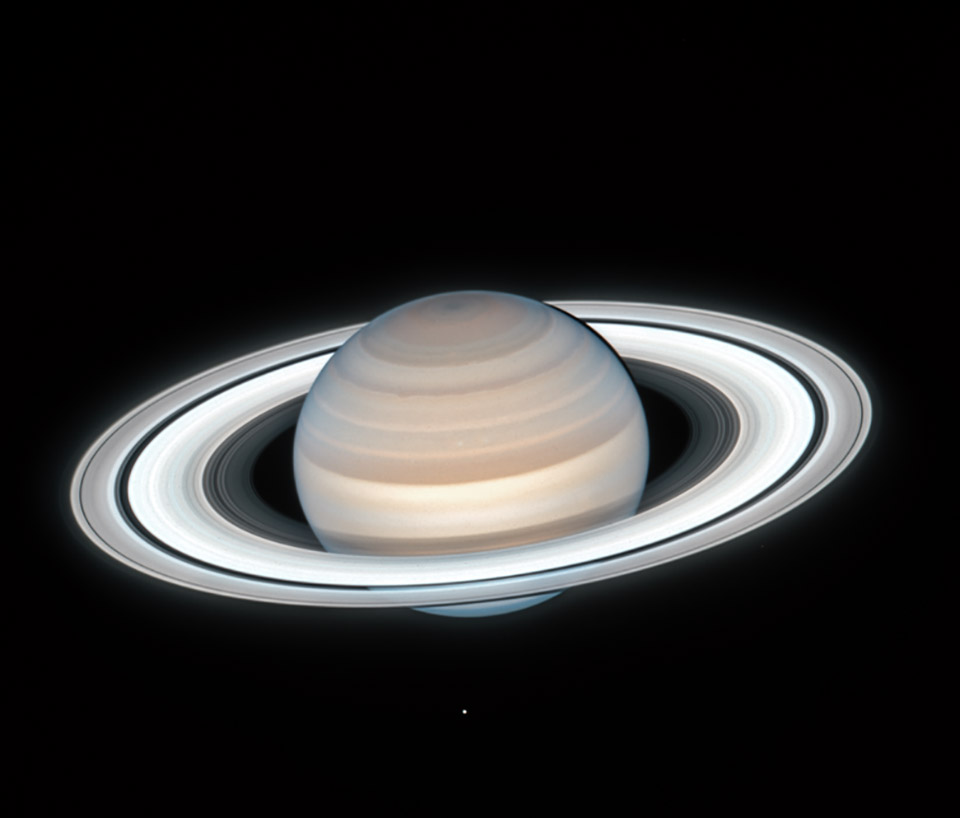
Both Saturn and our solar system have the same sphere / ring shape.
This dynamic process results in a distinctive structure: a dense, central sphere surrounded by a thin, equatorial disk, with both components rotating in the same direction. While this might suggest a balanced two-part system, the mass distribution is typically lopsided, heavily dominated by the central body. For example, in our solar system, the Sun contains about 99.8% of the system’s total mass, while the planets hold about 98% of the angular momentum.
All the material that went into creating our solar system, only 0.2% went toward creating the planets and moons, and only a small portion of this already small amount went toward creating the Earth. Yet the most important takeaway of this model is that all the planets and moons came from the same interstellar cloud of gas and material that was originally revolving around the Sun.
This combination of forces – gravity pulling mass together, angular momentum conservation, and centrifugal effects producing a fast-spinning sphere and disk - works on a surprising range of scale. Besides the creation of solar systems, we see smaller versions of solar systems in ring and satellite systems that orbit all of the large outer planets of our solar system. We also this these sphere/ring objects in the shape of spiral galaxies.
Despite the vast difference in size, we can think of the stars that come together to form a spiral galaxy as analogous to the molecules and tiny dust particles that came together to form our solar system. The stars of a spiral galaxy can also be thought of as grains of sand in a desert dust storm, in that they have no ability to stick together and grow into a much larger mass. Likewise, we should ask how the molecules and tiny dust particles of the forming solar system were able to clump together to form the terrestrial planets, moons, and the many other solid celestial objects that make up our solar system.

Galaxy in Early Stage of Development

Rotating Galaxy in Medium Stage of Development

Rotating Galaxy in Medium or Advanced Stage of Development
While it would be nice to witness the formation of these sphere-disk systems, the time required for these processes may as well be infinite compared to our short lives. Although we realize that distant objects like galaxies are moving at incredibly high speeds, to us they will always appear as still images. For some cosmic objects, astronomers address this problem by gathering pictures of similar objects at different stages of development and, hopefully, assembling them in the correct order so that they can "witness" these cosmic events taking place.
Despite the vast difference in size, we can think of the stars that come together to form a spiral galaxy as analogous to the molecules and tiny dust particles that came together to form our solar system. The stars of a spiral galaxy can also be thought of as grains of sand in a desert dust storm, in that they have no ability to stick together and grow into a much larger mass. Likewise, we should ask how the molecules and tiny dust particles of the forming solar system were able to clump together to form the terrestrial planets, moons, and the many other solid celestial objects that make up our solar system.
Our solar system, and likely all solar systems, started out as a vast dust cloud that collapsed in on itself due to gravitational attraction. It also began rotating ever faster as it came together, and as a result, it started to leave behind a ring of material surrounding its equator. This ring of material itself began coming together as other smaller spheres orbiting the main sphere that eventually became the Sun. Just as with the larger solar system, each of these smaller spheres began rotating and leaving behind its own ring as it collapsed due to gravity. Even today, these rotating spheres, now known as the gaseous planets, are still shrinking. And each one of these gaseous planets has its own ring and satellite system, although, except for Saturn, most of the ring systems of these gaseous planets have faded away, leaving behind only their satellites.
Even though it is impossible for us to recognize these changes, it is important to understand that these planets and our solar system as a whole are changing: they are evolving. They are still shrinking and growing denser as the gases that make up these planets are drawn closer together.
We can understand the shrinking of these gas planets in terms of energy. The gravitational forces pulling the gas toward the center are nearly balanced by the kinetic energy of the molecules. Yet all of these planets are slowly shrinking in size because more energy is being radiated away from these planets than they are receiving.
While understanding the shrinking of gas planets is fairly straightforward, the evolution of terrestrial planets, moons, asteroids, and comets is a bit more involved and interesting.
Sticking Together
Traditionally, the standard solar system formation hypothesis states that the dust and particles in the orbiting disk began to clump together, first forming moon-sized protoplanets that later collided and stuck together to eventually form the planets we see today. While this model of planet formation may seem simple enough, it actually fails to explain a key aspect that turns out to be extremely important to understanding our solar system: how is it possible for small particles to clump together?
Cosmic dust grains are thought to increase in size by accumulating atoms and molecules from the surrounding gas. Although this process is fundamental to their growth, relatively few studies have examined how efficiently different particles adhere under varying temperatures and conditions, or how this affects overall grain development. As a result, both the formation of dust and the mechanisms governing its growth remain poorly understood.
To appreciate the subtleties of this problem, we need to think about the forces that hold matter together.

Bar magnet with iron filings aligned to the magnetic field: throughout space, small metallic particles are held together by magnetic attraction.
Nearly everything in existence is fundamentally held together by the fact that opposite charges attract. Why there should be such things as positive and negative charges that - merely by their existence - are attracted to each other is one of those questions that are so fundamental that it remains beyond our understanding. It is almost as fundamental as asking why our reality exists. There are simply some questions that are so fundamental that all we can do is be grateful that our reality exists in this fashion before moving forward in trying to understand how it works.
Besides the electrostatic force, there is also its cousin, the magnetic force. For ferromagnetic materials, tiny metallic particles have directional magnetic dipoles that are effective at attracting other tiny metallic particles. Hence, a speck of ferromagnetic material in space can attract nearby iron-rich dust with its magnetic field. Sparsely dispersed throughout space, there are extremely small metallic dust particles that are held together in this way.
While there are some notable large-scale exceptions - such as lightning strikes and the magnetic fields of planets - the vast majority of electrostatic and magnetic effects occur at the molecular or micrometer scale, and it is in this “small world” that electrostatic forces dominate.
Electrostatics works great as a means of attraction when the interaction involves two small, oppositely charged particles that are in close proximity to each other. However, as dust particles grow larger, the effectiveness of these forces wanes. Once cosmic dust particles reach their typical size of about 0.1 micrometer, two of these particles colliding together are just as likely to break into smaller pieces as they are to stick together.
This presents a significant problem for current hypotheses on the formation of planets or moons. And it is only recently that scientists have recognized that they do have an explanation for how cosmic dust could grow larger than grains of sand. While gravity works great as an attractor when at least one of the objects is the size of a small moon - about a hundred kilometers in diameter - how does one of these dust particles grow to be the size of a small moon?
 Comet
Comet
In more ways than most people realize, water - or water ice - acts as a kind of glue that holds matter together, a property that arises from its electric dipole nature. In contrast to dry, charged dust particles, whose ability to attract other particles fades as they grow larger, the electric dipole nature of water molecules enables them to continuously attract both charged and uncharged molecules. It is water molecules that enable particles to grow from their initial small size to being many kilometers in diameter. Then, once an object is several kilometers across, gravity is able to take over as the primary attracter of additional matter.
The next important realization is that water is much more commonly dispersed throughout the solar system than one might at first be led to believe. This statement itself may seem paradoxical since, other than Earth’s surface, water is actually rather difficult to find on most planets and moons throughout our solar system. We resolve this paradox by realizing that, while water is abundantly spread out among the planets and moons, typically very little, if any, water will exist on the surface of these planets and moons. This is because ultraviolet radiation will easily break apart water molecules in a process called photodissociation. A primary reason why Earth has been able to hold on to its oceans of water is because the UV radiation from the Sun is already used up in the atmosphere at it breaks apart oxygen molecules that are blocking the UV radiation from reaching the surface.
Because of photodissociation, most of the planets and moons close to the Sun are as dry as deserts. Yet, make no mistake: far beneath the surfaces of these objects, there is an abundance of water locked within their interiors. Beneath those surfaces, or at greater distances from the Sun, water - whether as liquid or frozen ice - can be widespread. Comets and distant Kuiper Belt objects, far from the Sun, are often 50 to 70 percent frozen water, while many moons of the outer planets are composed largely of ice rather than rock, and the inner rings of Saturn are nearly 100 percent frozen water.
The reason water is so widely dispersed throughout the solar system is because water was glue that enabled these objects to grow into being the large objects that they are today. Without water, no large objects could form and our solar system would remain forever a cloud of revolving dust.
We can gain further insight into water’s role in the formation of the solar system - and the development of satellite systems more generally - by carefully studying and correctly interpreting the evidence provided by Saturn’s ring–moon system.
Saturn's Rings: The Key to Understanding Our Solar System
The classical explanation of Saturn’s rings is an excellent example of how initial scientific investigators often draw the wrong conclusions about a phenomenon, and later scientists become stuck in the dead-end paradigm that the earlier scientists created.
In 1610, Galileo was the first to observe the rings of Saturn, but he did not understand what he was seeing because his telescope was too weak to create an unambiguous image. It was not until 1655 that Christiaan Huygens - using a more powerful telescope - recognized that Saturn was surrounded by a thin, flat ring that did not touch the planet. After this, it was not until the late 1800s before astronomers felt they had a reasonable explanation for why Saturn has rings. Yet, while this ‘torn apart moon’ explanation seemed to make sense at the time, more recent evidence shows that this classic explanation is wrong.
To explain the origin of Saturn’s rings, astronomers proposed that one or more of Saturn’s moons drifted too close to Saturn and consequently it was torn apart by tidal forces. A key part of this hypothesis was the introduction of the Roche limit - the calculated minimum distance at which a weakly held together satellite can orbit a planet without being torn apart by tidal forces.
Let’s go over the primary evidence clarifying the fact that Saturn’s rings are not the remnants of a torn-apart moon or moons.
Roche Limit is Misleading – Because gravity attracts objects together, it might seem like common sense that orbiting moons would slowly drift toward their host planet. However, this is not the case. Saturn’s moons, like Earth’s moon and the vast majority of moons, have a prograde orbit, meaning they orbit in the same direction as the planet rotates. The gravitational pull of these moons distorts the host planet, which in turn produces a slight tug on the moon directed away from the planet. In summary, contrary to what is implied by the Roche Limit explanation, moons generally do not drift toward their host planet. Instead, as these moons continuously orbit a planet, they are also very slowly drifting further away.
The Water Ice of Saturn’s Rings Is Far Too Clean – If Saturn’s rings came from a shattered moon, we should see significant amounts of rock and dust in the composition of Saturn’s rings. But Saturn’s rings - especially the innermost visual ring, the B ring - are far purer than its moons. Instead of the rings’ composition matching that of the moons, there is actually a distinct gradient in purity starting from the inner ring to the larger outer moons. Saturn’s inner B ring is about 99.9% pure water ice, the next ring out is about 99% pure, the small moons that are farther out are 90 to 95% pure, while the larger moons that are still further out are 50 to 90% pure.
Saturn’s Rings Are Extremely Young – Similar to how our bookshelves get dusty if they have not been cleaned for a while, objects out in space also get dusty over time, and we can get a sense of how old these objects are by how much dust has accumulated. The fact that Saturn’s nearest ring is 99.9% pure water ice indicates that these rings are very young indeed - possibly no more than ten million years. Furthermore, the progression of these objects becoming increasingly dirtier the farther we move outward indicates that the objects farthest away from Saturn are the oldest.
The Source of Saturn’s Rings Has Been Identified – To create the nearly pure water ice chunks that make up Saturn’s B ring requires a source of nearly pure water. In 2017, the Cassini spacecraft passed through the gap between Saturn and its rings and, in doing so, detected charged water-group ions (H₂O⁺, HO⁺, and O⁺). These charged ions, either by themselves or combined with hydrogen atoms, form the water that creates the rings. Furthermore, the fact that these are all positively charged ions means that even an extremely modest electrostatic field gives them the ability to overcome Saturn’s gravitational field: an electric field is lifting these ions up to Saturn’s rings.
This evidence indicates that while the scientists of the late 1800s thought they had figured out the origin of Saturn’s rings, they had actually got the process backward: instead of Saturn’s moons drifting inward and then being ripped apart to form the rings, water isotopes are being lifted up from Saturn’s equator before solidifying into a ring of countless tiny ice chunks. From this moment on they have been growing steadily larger as they bump into and stick to other ice clumps, while at the same time cosmic dust has been collecting on their surfaces. Eventually these dirty ice chunks become so large that they are identified as moons, the smaller moons having odd potato shapes while the larger moons succumb to the stronger gravity and internal heating that causes them to take on a spherical shape.
Despite substantial new evidence about the evolution of Saturn’s rings - particularly the implausibility of torn-apart, extremely dirty moons producing 99.9% pure ice - it is difficult to understand why the astronomy community has not moved quickly to correct their mistake. In fact, in their own way, they are trying. Recognition that there may be problems with the traditional explanation was likely a factor in planning the 2017 Cassini mission. Yet, surprisingly, when positive water ions were discovered between Saturn and its rings, instead of recognizing that these charged particles are moving outward to the rings - thus explaining the high purity of the inner rings – leading astronomers conveyed hardheadedness by misinterpreting the evidence to mean that the water ions are raining down from the rings. One is left to conclude that it is difficult for these scientists to give up their old, incorrect belief; for most astronomers, the idea that Saturn’s rings are the remnants of torn-apart moons is one that they have held since childhood - perhaps this explanation even inspired them to pursue astronomy as a career.
Moving on, with Saturn’s ring–moon system we are able to witness in real time the creation of moons, and this gives us insight into how all moons were created, and indeed, insight into the formation of the planets themselves.
Having the correct explanation of how the moons and planets formed is much more than a history lesson; it is what gives us a true understanding of our solar system.
With Saturn’s rings, we see how moons are created: first, water-ice particles are spun off Saturn’s equator; they grow larger by sticking together and also become dirtier by gathering cosmic dust. Faster growth becomes possible once they become large enough for gravity to pull in surrounding material, and at this point they begin to take on a rounded shape. Ice is the “sticky” material that enables cosmic dust to come together and eventually form moons.
We must now ask whether Saturn’s ring–moon system is a special case or the key to understanding the formation of our solar system.

Open Telescope Observatory
Saturn is not the only gas giant with a ring system: Jupiter, Uranus, and Neptune all have rings. However, these ring systems are harder to see because they are much smaller and darker. They also differ from Saturn’s in that, while Saturn’s rings are nearly 100% water ice, the rings of the other planets contain little, if any, water. We might question whether there is any real connection among these systems - until we examine the composition of their moons.
Like Saturn’s moons, the moons of the other outer planets are mixtures of ice and rock. This suggests that their moons formed in a similar way: ice particles were first ejected from the planet’s equator, then clumped together, gathered dust, and eventually grew into moons. The reason Saturn’s rings are bright while the others are faint is that, unlike Saturn, these planets likely stopped supplying fresh ice long ago. Over billions of years, ultraviolet radiation has eroded their rings by breaking apart water molecules—a process that affects small ring particles far more than large moons. This helps explain why the ring systems of Jupiter, Uranus, and Neptune are so diminished and largely depleted of water.
On a larger scale, the Sun and its orbiting planets resemble these giant planets and their satellite systems. This raises the question: was ice also a key component in the formation of the planets?
While our solar system was forming - before the fusion process began that lit our Sun - this region of the galaxy must have been an extremely cold place. With temperatures close to absolute zero, the contracting solar system would have been throwing off water ions that would quickly freeze. Considering the extremely cold conditions that must have existed before the Sun’s fusion process began, there were possibly other icy compounds forming as well as water ice. During the early stages of the solar system, it was these icy water crystals and other icy substances that enabled rocky material to stick together and eventually grow into planets and moons. Billions of years later, much of this water is still trapped inside these planets and moons, while the objects that formed on the outskirts of the solar system have hardly changed at all: they are still just dirty chunks of ice.
The fact that Saturn’s rings are nearly pure frozen water and are extremely young, relatively speaking, while the outer moons are much older, provides a clue to what is happening. Saturn is contracting in size, which, because of the conservation of angular momentum, causes it to spin faster. The planet’s rotation produces a centrifugal effect that tends to throw material off the planet, and this effect is strongest at the equator. Usually, the molecules most likely to escape are the lightest ones, such as hydrogen and helium, because they move faster and can exceed the planet’s escape velocity. However, the molecules with the best chance of escaping are charged water ions, because they receive additional acceleration from electrostatic forces lifting them away from the planet. After being ejected into orbit, these water ions can combine with hydrogen to form ice crystals - crystals that continue to grow by sticking to one another until they become visible as Saturn’s rings.
The reason this discussion has focused on Saturn’s rings is that they serve as a “real-time display” of how frozen water plays a central role in the formation of moons and planets. Most objects in the solar system likely began as frosty, orbiting blocks of ice - primarily water ice, though in the early stages of the solar system there was also carbon dioxide ice and possibly other frozen compounds as well. Many bodies in the solar system are either composed largely of such frozen, dust-laden ice or contain, or once contained, cores formed from water ice or mixtures of water and carbon dioxide ice.
Is Saturn Shrinking?
As stated earlier, there is a progression in the amount of dust on the objects orbiting Saturn: Saturn’s inner B ring is about 99.9% pure water ice, the next ring out is about 99% pure, the small moons farther out are 90 to 95% pure, while the larger moons still farther out are 50 to 90% pure. Furthermore, since the amount of dust that accumulates correlates with the age of these objects, this means that while the inner rings may be only a few million years old, the outer moons may be more than a billion years old. This progression of age correlating with these objects’ distance from Saturn implies that, for the last billion years or so, once ice formed near Saturn’s surface, it has been steadily drifting away from Saturn.
Or so it appears.
Earlier it was explained that - contrary to what is implied by Roche Limit, and against what must seem like common sense - orbiting moons do not normally drift towards their host planet. Yet at the same time, when there are numerous moons orbiting a planet, these moons are not all that motivated to move away from the planet either.

Because of its proximity, the tidal bulge that is closer to the Moon as the greater effect, and because this bulge is leading the Moon it is applying a slight forward pull that slowly sends the Moon to a higher orbital.
While it is true that Earth’s moon is slowly drifting away from Earth, this phenomenon of prograde-orbiting moons slowly moving away from their host planet may not as strong for other satellite systems.
The reason Earth’s moon is slowly moving away from Earth is because the pull of the Moon creates a tidal bulge on the Earth that slightly leads the orbital movement of the Moon, and this in turn tends to pull the Moon into a higher orbit. Hence, there needs to be this tidal bulge on the host planet to produce this phenomenon. For most of the satellite systems in our solar system, the moons orbiting their host planet are not nearly as large in comparison to their host planet, and so their ability to create a significant tidal bulge to produce this effect is not nearly as great. Consequently, some of these moons in prograde orbits may still be slowly moving away from their host planet, but they will do so at an even slower rate than the slow outward movement of Earth’s moon.
When we specifically consider the outward movement of Saturn’s rings and moons, the near uniformity of these objects orbiting Saturn means that the outward movement is almost nonexistent.
But if the rings and moons of Saturn are all but locked in their orbital distances, how is it that there is this progression of younger to older orbiting objects as we travel away from Saturn? The answer is that movement is relative. It is not so much that these objects are moving away from Saturn as it is that the surface of Saturn is moving away from them: Saturn is shrinking.
Over billions of years, as Saturn collapsed in on itself, its rotational speed increased due to the conservation of angular momentum. Yet with greater rotational speed comes greater centrifugal force attempting to throw material off at its equator. Consequently, as Saturn is shrinking, it is also throwing off material at its equator - the latitude where the centrifugal force is the greatest. Furthermore, the material that it is throwing off is the positive water ions, because in an electric field the positive charge of these ions gives them an extra lifting force over the neutral charged material. For all the time that Saturn has been shrinking, it has been leaving behind rings of ice crystals that, over time, have clumped together while collecting dust and eventually evolving into the moons of Saturn.
Finally, Saturn is not an outlier among the gaseous planets but rather is simply the last one in completing this stage of its evolution. Not only do all of the other large gaseous planets have satellite systems - moons consisting of a mixture of ice and rock - but all of these planets have faint icy rings.
Still, we can expand this idea even further to consider how the solar system itself formed. In the early stages of the formation of our solar system this collapsing ball of material must have had a radius greater than the orbital radius of Neptune. As it contracted it was leaving behind a thin ring of icy crystals that, in a process similar to the formation of Saturn’s, began forming the nucleus of the future planets. These early planets themselves were themselves drawing together large clouds of material whose radii were initially much larger than what these planets currently have. As the Sun shrunk while leaving behind this material in the elliptic plane, the forming planets in this elliptic plane were also shrinking while leaving behind a ring of material revolving around their equators.
Orbital Spacing of Moons and Planets
Because Saturn’s rings are an even distribution of ice chunks, from Earth, the rings look like a continuous sheet of material. However, further out, beyond the rings, we no longer see this sheet of material because it has all been gathered up by the orbiting moons. The reason for this change is that once some of these ice chunks become fairly large - the size of small moons - gravity then becomes effective in attracting and gathering up all the remaining small ice chunks. Besides removing the smaller ice chunks, the gravitational force also brings together many of these smaller moons.
Gravity is the attractive force between the center of mass of one object and the center of mass of another object. If these objects are isolated in space, such as when a small object approaches a much larger moon or planet, it is fairly easy to calculate the acceleration and movement of the smaller object as it is attracted to the much larger moon or planet. However, when these two objects are closer in size and are orbiting a much larger third object - such as the case for two moons orbiting a planet - determining the movements of these objects can be surprisingly complicated and even difficult to accurately predict. In astrophysics and rocket science, this is known as the three-body problem.
The speed of a moon orbiting a planet is determined by the radius of its orbit: the greater the radius, the slower its speed. Hence, if there are two moons orbiting a planet, the moon in the lower orbit will travel faster and eventually pass the slower moon at the higher orbit. Furthermore, if the orbits of these two moons are close to each other, the two moons will be strongly attracted to each other as one moon passes the other. The paths of these moons may change as a result of this gravitational attraction.
During this close encounter, there is an exchange of energy. As the fast moon in the lower orbit is approaching, it gains energy because the other moon is pulling it forward. After it passes, it loses energy because the pull from the other moon is slowing it down. Yet, out of the whole exchange, the fast moon in the lower orbit will gain more energy than it loses. The effect of this gain in energy is that the moon in the lower orbit is slowly moving into a higher orbit.
Because all forces are equal and opposite, a similar yet opposite result occurs with the moon in the higher orbit. Each time it is being passed, it first feels a pull slowing it down, and then, after the faster moon goes by, the moon in the higher orbit feels a pull speeding it up. Yet the total effect of these pulls is that the moon in the higher orbit is losing energy, and so it is slowly falling into a lower orbit. Consequently, with every orbital pass, these two moons are slowly coming ever closer to being in the same orbit.
Once these moons come really close to each other, depending on how they approach and the differences in their mass, a variety of outcomes are possible. If the two moons are nearly the same mass, it is possible that they will start doing a little "dance" where they switch orbitals every time they come near each other. Another possibility is that the pull from the larger moon will send the smaller moon off in an odd direction. And of course, there is also the possibility that one moon will simply collide with the other to create a single larger moon. The upshot of this chaotic evolution is that the surviving moons often end up in a dynamically stable configuration, with orbital radii that may exhibit roughly geometric spacing and/or orbital resonances.
| Moon | Orbital Period (days) |
Ratio to Io |
|---|---|---|
| Io | 1.769 | 1 |
| Europa | 3.551 | 2.007 |
| Ganymede | 7.155 | 4.043 |
| Callisto | 16.689 | 9.43 |
The classic example of this orbital resonance is seen in the major moons of Jupiter. Their orbital spacing is based on the resonance of their orbital periods. The orbital periods of Io, Europa, and Ganymede are in a 1:2:4 resonance, meaning that as Io - Jupiter’s closest large moon - completes four orbits, Europa completes two, and Ganymede completes one. Besides these first three moons, there is also Callisto, which - being on moon that is furthest away - is not caught up in this resonance pattern. This resonance pattern - the doubling of the periods - makes for the most stable orbital positions when the moons are fairly large.
Because Saturn’s moon system is still a "work in progress," the resonance pattern is not so obvious for these younger, smaller moons. But look closer: Tethys’ orbital period is twice that of Mimas, and likewise, Dione’s orbital period is twice that of Enceladus. These four moons are intertwined even more since these two resonance patterns are overlapping. For these moons - Mimas, Enceladus, Tethys, and Dione - the next moon further out has a period that is about 1.43 times greater. Unlike Jupiter’s moons, these intermediate positions are currently still stable because these much smaller moons of Saturn have weaker gravitational fields, and so the closer spacing is tolerable.
| Moon | Orbital Period (days) |
Ratio to Mimas |
|---|---|---|
| Mimas | 0.942 | 1 |
| Enceladus | 1.370 | 1.45 |
| Tethys | 1.888 | 2.00 |
| Dione | 2.737 | 2.91 |
While it is possible to make some sense out of the spacing of these moon systems, that is not to say that there is rhyme or reason to the spacing of all the moons of our solar system.
Beyond Dione, there isn’t really much of a clear resonance pattern for Saturn’s more distant moons: Rhea, Titan, Hyperion, and Iapetus. The same goes for the moon systems of Uranus and Neptune; for either of these moon systems, there is no clear resonance pattern similar to Jupiter’s moons.
This brings us to the Titius-Bode Law, which gives the spacing of the planetary orbits in our solar system.
In 1766, Johann Daniel Titius published his discovery of a simple numerical pattern that matched the orbital spacing of the planets. This mathematical rule was later popularized by Johann Elert Bode and is now known as the Titius-Bode Law.
The rule begins with the sequence 0, 3, 6, 12, 24, 48, 96, 192, 384. Adding four to each of these numbers gives 4, 7, 10, 16, 28, 52, 100, 196, 388, and then dividing each result by 10 yields 0.4, 0.7, 1.0, 1.6, 2.8, 5.2, 10.0, 19.6, and 38.8. These numbers correspond to the orbital radii of the planets in astronomical units (AU), with 1 AU being the orbital radius of Earth.
| Planet | n value | Predicted (AU) | Actual (AU) |
|---|---|---|---|
| Mercury | –∞ | 0.4 | 0.39 |
| Venus | 0 | 0.7 | 0.72 |
| Earth | 1 | 1.0 | 1.00 |
| Mars | 2 | 1.6 | 1.52 |
| Asteroid belt | 3 | 2.8 | 2.77 |
| Jupiter | 4 | 5.2 | 5.20 |
| Saturn | 5 | 10.0 | 9.58 |
| Uranus | 6 | 19.6 | 19.18 |
| Neptune | 7 | 38.8 | 30.07 |
- n = −∞ for Mercury, and then
- n = 0, 1, 2, 3, … for Venus, Earth, Mars, etc.
- Our solar system, and all other solar systems, formed from the gravitational collapse of a molecular cloud. As the cloud collapsed, its rotational speed increased, causing it to leave behind a disk of material around its equator. The central sphere of material eventually became the Sun, while the material revolving around its equator eventually became the planets and other objects that make up our solar system.
- A lot can happen in 4.6 billion years. Even though nearly every planet looks different from the others, we need to keep in mind that all the planets of our solar system formed out of the same swirling disk of material. Planets and the other celestial objects of our solar system have evolved, and we cannot fully understand these objects without understanding how they evolved.
- Ice played a key role in facilitating the clumping together of the material swirling around the Sun. The electrostatic holding force of ice is what enabled tiny specks of cosmic dust to grow to become the size of moons or planets.
- As these objects grew in size, this ice - mostly water ice - became trapped in their interiors. For some moons and objects along the outer reaches of our solar system, this water is still trapped within their interiors. Whereas for most other objects nearer to the Sun - the objects that have evolved - most of this ice has melted, migrated to the surfaces of these objects, and escaped into space.
- Saturn’s ring and satellite system is a real-time display of how ice facilitates the formation of terrestrial objects. The process begins in the region between Saturn and its rings, as charged water ions come together to form small chunks of ice. From this point on, these ice chunks grow larger as cosmic dust settles on their surfaces, while they bump into and stick together, growing ever larger. Eventually, some dirty ice chunks grow so large that gravity becomes effective in speeding up the process of gathering up the remaining ice chunks. Of the many moons, the final survivors will be the ones that are spaced apart in orbits whose periods are in resonance with the orbits of other moons.
- Io –The extreme volcanic activity of Io can be explained by its exceptionally high gravitational gradient (80 × 10⁻¹² s⁻²), its relatively large size, and its short orbital period, which causes it to be stretched more frequently than nearly all other moons.
- Europa – Although Europa has a fairly high gravitational gradient (47 × 10⁻¹² s⁻²), it is only about half as massive as Io, and its orbital period is twice as long - meaning it is stretched less often. As a result, its interior is not heated nearly as much as Io’s.
- Ganymede and Callisto — The gravitational gradients for these two moons are far too low to produce significant stretching, and thus they generate very little internal heat.
- Enceladus — At 160 × 10⁻¹² s⁻², Enceladus has the highest gravitational gradient of all the listed moons. However, it is much smaller than the others, and these factors tend to offset each other. As a result, while it does exhibit ice geysers, tidal forces are not generating a large amount of internal heat.
- Titan — Titan has a gravitational gradient that is just strong enough, combined with its large mass, to produce some geological activity.
- The Role of Astronomy in Ancient Monuments - The Archaeologist
- Ancient Observatories around the World - NETGELVIN
- Ancient Observatories - STANFORD SOLAR CENTER
- Ancient Observatories - Teach Astronomy
- Is There Such A Thing As “Destiny”? - Living in Wellbeing
- Destiny: Is it a reality or a superstition? - Psychology Spot
- Destiny - Free Dictionary
- The Condensation Theory - Chaisson
- An Overview of the Solar System - Bill Arnett
- Cosmic Dust - David Darling
- How Do Magnets Work? - Science News Today
- Magnetism - Geeks for Geeks
- Ferromagnetism - Hyperphysics
- Attraction Of Magnets - Magnet Manila
These numbers can also be generated by using the formula:
A = 0.4 + 0.3×2n
Where:
With the exception of the last planet, Neptune, the Titius-Bode Law is surprisingly good at predicting the actual planetary distances. However, this is somewhat problematic for the astronomy community because they still have not come up with a reasonable explanation for why it works.
In modern times, the discovery of numerous exoplanet systems has led astronomers to wonder if the planets of these exoplanet systems might also follow the Titius-Bode Law. Currently, the answer to this question could be either yes or no, depending on one’s interpretation of the data. Just as the moon systems in our own solar system do not all show resonance patterns, some of the exoplanet systems show logarithmic spacing of their planets that is similar to the Titius-Bode Law, while some do not.
What is interesting about our solar system’s orbital spacing pattern - the Titius-Bode Law - is why there should be a 0.4 added to all the values, and how is it that the spacing does not appear to be based on the resonance of the planets’ periods?
Heaven: Part 2
Esker's Theory of Planetary Evolution
While our primary quest is to understand how Earth’s atmosphere could have changed over time, we are more likely to achieve this goal by recognizing how all of the planets have changed over time rather than just focusing on Earth. By stepping back to see the broader perspective of Earth being just one of several planets, and by taking a more scientific approach to applying scientific concepts, we will develop a better understanding of not just Earth but all the planets in general.
During this path of discovery, we have laid out several new ideas that now form the foundation for future progress. Here is a summary of those ideas.
To understand our solar system, we need to first recognize that it is extremely old: billions of years old. While it is typically stated that Earth is 4.6 billion years old, this age is more accurately applied to our solar system, since it is based on the radioactive dating of meteoroids that have come from the asteroid belt. Yet the main point here is that we should realize that, in all likelihood, an incredible amount of change could have taken place over the course of billions of years. If we really want to understand our solar system, then we need to understand how it has evolved between then and now. To do that, we need to correctly identify the mechanism that causes planets and moons to evolve
In Chapter Seven – Hell - the evidence-supported arguments were given for determining whether leftover primordial heat, radioactive heating, or tidal heating was the source of Earth’s internal heat. The chapter finished with the conclusion that tidal heating is the source of Earth’s internal heat. Now, this question is being expanded to what heats the interiors of planets and moons in general, and, in doing so, to explain the geological activity seen on several moons and planets in our solar system.
While many geologists favor primordial heat or radioactive heating to explain Earth’s internal heat, planetary scientists favor tidal heating to explain the extreme geological activity of Io, Jupiter’s nearest moon. In addition, besides tidal heating explaining the most geologically active object in the solar system, planetary scientists are starting to realize that tidal heating works well in explaining the internal heating of other moons and planets as well.
Thus, we currently live in confusing times. While it is not impossible for there to be more than one mechanism for explaining a phenomenon, this is rarely the case. In all likelihood, one of these mechanisms - tidal heating or radioactivity - is correct for explaining what heats the interiors of terrestrial planets and moons, while the other proposed mechanism is simply wrong.
Let’s investigate how tidal forces work so that we can better understand the connection between the evolution of moons and planets and the density of these objects.
Gravitational Gradient and Synchronous Rotation
To better understand why one planet or moon is heated more than another, we must evaluate the strength of the gravitational gradient. Once this is known, we can consider additional factors, such as the mass of the planet or moon and the frequency of its deformation, to determine how much internal heating occurs and how this heating influences the evolution of these celestial bodies.
To calculate the gravitational gradient, we begin with the equation for gravitational attraction:
where F is the force, G is the universal gravity constant equal to 6.67 E-11 N m2/kg2, M1 and M2 are the mass of object one and object two, and R is the distance between the center of the mass of the two objects.
From this equation we see that the strength of the gravitational field g is given as:
The strength of the gravitational field is good to know when we want to know the strength of the gravitational pull that one mass will have on another mass, especially when one mass is much larger than the other. For example, we can plug into this equation the values for the universal gravitational constant G, the Earth’s mass, and its radius to calculate the gravitational field near the Earth’s surface to be 9.8 m/s², and once we have this value, we can calculate the weight of objects on its surface using the equation F = m g. We can use this equation to calculate our weight while standing on the Earth’s surface.
| Jupiter’s moons |
Δg/ΔR (10-15 s-2) |
Rotation |
|---|---|---|
| Io | 3370000 | Locked |
| Europa | 839000 | Locked |
| Ganymede | 207000 | Locked |
| Callisto | 38100 | Locked |
| Earth’s moon | ||
| Moon | 14100 | Locked |
| Planets | ||
| Mercury | 1375 | Slow |
| Venus | 211 | Slow |
| Earth | 258* | Fast |
| Mars | 23 | Fast |
| Jupiter | <1 | Fast |
| Saturn | <1 | Fast |
| Uranus | <1 | Fast |
| Neptune | <1 | Fast |
However, for now, we are interested in calculating something known as the gravitational gradient.
When we take the derivative of the gravitational field equation, we get the gravitational gradient:

where Δg/ΔR is the gravitational gradient, G is the universal gravitational constant, M is the mass of the central object (such as the Sun or a Jovian planet), and R is the distance from that object. The negative sign indicates that the gradient decreases with increasing distance.
Looking at the table, we see how the strength of the gravitational gradient determines the rotational status of a planet or moon: if it is extremely high, then it is locked in synchronous rotation, while at the other extreme, a low gravitational gradient has little, if any, effect on slowing down the rotation of a planet. Furthermore, it is not a coincidence that all the moons are locked in synchronous rotation while all planets are not: because moons are much closer to their host planets than planets are to the Sun, and the strength of gravitational gradients largely depends on proximity, the extremely strong gravitational gradients that moons experience quickly lock them into synchronous rotation.
Synchronous rotation means that the moon is rotating at the same rate that it is revolving, so that the same side of the moon is always facing the host planet. This happens because while these moons are close to having a spherical shape, the tidal forces tend to stretch these objects so that they bulge a little bit both in the direction of the pull and away from the direction of the pull. This slight elongation is all that is needed to keep the same side always facing the host planet. While the table only shows the moons of Jupiter and Earth’s moon, actually, all the major prograde orbiting moons in our solar system are locked in synchronous rotation.
In contrast to the moons all being locked in synchronous rotation, all of the planets rotate freely, and it is easy to see why by just looking at the table giving the gravitational gradients. Of the moons listed, the gravitational gradient experienced by Earth’s moon is more than ten times greater than the strongest gravitational gradient experienced by any planet.
Most planets spin at a fast rate, thus indicating that at the greater distances they are from the Sun, the gravitational gradient is too weak to really affect them. However, this is not necessarily true for the planets that are close to the Sun. The stronger gravitational gradient near the Sun is probably the reason why both Mercury and Venus have slow rotations, and given enough time, it is possible that these planets will eventually lock into synchronous rotation with the Sun.
Meanwhile, Earth has a surprisingly fast rotation even though it is in a moderately strong gravitational gradient. However, Earth’s moderately strong gravitational gradient is more due to its attraction to its moon rather than its attraction to the Sun. Eventually, Earth may also lock into synchronous rotation, but it will most likely be locking with the Moon rather than with the Sun.
Tidal Heating and Density
When an object is in the presence of a gravitational gradient, forces are applied to the object that attempt to stretch it in the direction aligned with the gravitational gradient. If these tidal forces are strong enough to distort the object, then heat will be generated within it as it distorts to take on a new form. Tidal heating is a form of frictional heating - the general process in which surfaces rub as one slides over another. This process can be understood through familiar examples of frictional heating.
A quick and easy way to warm your hands on a cold day is to simply rub them together. While this will generate a modest amount of heat, numerous mechanical devices can get quite warm as a result of fast-moving parts rubbing against each other as they slide past one another. Usually, we like to lubricate these surfaces to reduce energy loss, noise, and wear and tear on the parts. At other times, however, we want to increase friction, such as when we use brakes to slow the movement of a vehicle. Whenever we apply the brakes of a car, truck, or other vehicle, we generate heat between the brake pads and the rotating discs as the brakes slow the wheels.
Tidal forces often act like brakes, slowing down the rotation of planets or moons. While the stretching of a rotating planet or moon is mostly aligned with the direction of the gravitational gradient, it is actually a few degrees off due to the rotation. The stretching is slightly misaligned with the direction of the tidal forces producing it because there is a slight delay between when the forces are applied and when the object moves to a new position in response to them. This slight misalignment is enough to produce a braking component that slows the rotational speed of the rotating planet or moon. Depending on the strength of this braking force, the freely rotating planet or moon will eventually slow down and lock into synchronous rotation after millions of years or, more likely, many billions of years.
Somewhat similar to how heat is generated at the brake pads while the brakes are being applied to slow down a vehicle, rotation planetary objects are also being heated internally every time they are distorted while simultaneously their rotation are being slowed by the tidal braking.
Earth and its Moon provide evidence of how tidal forces can generate internal heat while slowing the rotational speeds of planetary bodies. For Earth, it is easy to observe how the Moon’s gravitational pull produces the twice-daily rise and fall of the tides. As a reminder, it is not just the water but also the ground itself that rises and falls in response to tidal forces. These forces produce internal frictional heating within Earth as they cause it to constantly distort. In addition, because the tidal distortions are not quite aligned with the tidal forces, there is a braking torque that slowly reduces Earth’s rotational speed. Even though Earth’s rotation is slowing down, it will not lock into synchronous rotation for several more billion years. This was originally explained in Chapter Seven: Hell.
The Moon is already locked into synchronous rotation with Earth, and this happened billions of years ago. Consequently, the Moon’s interior is cold, and, for all practical purposes, there is no longer any significant geological activity occurring anywhere on the Moon. Yet, that being said, there is clear evidence that plenty of geological activity occurred not long after the Moon came into existence.
When we look at the near side of the Moon, we notice that nearly half of its surface is distinctly darker than the remaining light grey surface. These dark grey surfaces are lava plains called lunar maria. The name comes from early astronomers’ interpretation that these were large seas, when they are actually broad deposits of basalt, a volcanic rock that formed when molten material erupted onto the lunar surface and cooled.
It is unlikely that Earth’s Moon formed in the same way as the other moons of our solar system. Whereas the formation of the moons that surround the large gaseous planets is exemplified by Saturn’s ring/moon system, Earth’s Moon is best described as the smaller partner in a binary planet system. A planet’s ring/moon system produces numerous moons that are much smaller than their host planet, and from the start, they are locked in synchronous rotation. Earth’s Moon, however, is more comparable in size to Earth, with a mass one-eightieth that of Earth. It is Earth’s only moon, and when it formed, it was most likely rotating freely, similar to Earth and the other planets of our solar system.
In the early years of the Moon’s existence, the freely rotating Moon was experiencing a strong braking torque and intense heating due to its orbiting within Earth’s relatively strong gravitational gradient field. In fact, the tidal forces being applied to the Moon were even stronger than one might at first imagine, since the early Moon was actually much closer to Earth. We know that the early Moon was closer to Earth because it is currently moving away from Earth. Billions of years ago, not only were the tidal forces being applied to the Moon much stronger, but the tidal forces that the Moon applied to Earth were also much stronger.
The consequence of these strong tidal forces acting on the Moon is that its interior was intensely hot during its early years, resulting in the melting of interior rock and the subsequent outpouring of molten lava onto its surface. Because there are virtually no erosion processes occurring on the Moon, we can still clearly see these lava basins that were created billions of years ago.
In contrast to the Moon, which went through a rather quick braking process resulting in intense heating over only several million years, the planets of our solar system are rotating in orbits far from the Sun and so they are in much weaker gravitational gradient fields. Because of this, they are slowing down at a much slower pace.
It is understandable that Mercury and Venus are two of the slowest-rotating planets in our solar system. Their close proximity to the Sun means that they are orbiting in gravitational gradient fields that are much stronger than those experienced by planets that are farther away. For billions of years, tidal forces have been slowing down their rotation, and eventually, billions of years from now, there is a strong chance that they too will lock into synchronous rotation.
Besides slowing down the rotation of these planets, there is another interesting aspect of how these tidal forces have heated their interiors and the volcanic activity that resulted from this internal heating.
Both Venus and Mercury show extensive evidence of past volcanism, including vast lava plains. The main difference between the two is that while the lava plains on Venus appear to be relatively young and it is possible that Venus is still experiencing volcanic eruptions, Mercury does not appear to have experienced volcanic activity for at least a couple of billion years.
This evidence makes sense in terms of the strength of the gravitational gradients that these two planets are experiencing. Mercury, being closer to the Sun and therefore experiencing a greater gravitational gradient, is somewhat comparable to Earth’s Moon in that the stronger gravitational gradient caused these objects to go through their evolutionary development at a faster pace.
One possible reason why the astronomical community is only now beginning to realize that tidal heating is the primary driver in the evolution of planets and moons is that the amount of tidal heating that occurs within a planetary object does not depend on a single factor. In comparing Mercury and Venus, it is possible to point to the difference in their gravitational gradients to explain why Mercury has completed its evolutionary development ahead of Venus. While the strength of the gravitational gradient is usually the most important factor, there are also other factors that may play a significant role in determining outcomes. Sometimes, one of these factors can be even more important than the strength of the gravitational gradient.
For example, if all the planets started out the same in all respects other than being spaced out in their respective orbits, it would be much easier to recognize how the successive differences in the gravitational gradients they experienced produce differences in how much volcanic activity takes place and how quickly this activity occurs. Mercury would have the most volcanic activity, followed by Venus, Earth, and Mars. Furthermore, Mercury would complete its volcanic activity first, again followed by Venus, Earth, and Mars. In this idealized model, it would be easy to recognize the connection between orbital position, the strength of the gravitational gradient, internal heating that produces volcanic activity, and how quickly this tidal heating takes place. However, the variations between these planets produce much more complex results.
***
***
This process of generating heat inside a rotating celestial object is not unique to the Moon. Currently, all of the terrestrial planets - Mercury, Venus, Earth, and Mars - experience tidal forces that generate heat within their interiors while simultaneously slowing down or otherwise adjusting their rotations. The reason the Moon completed this process so quickly is that its close proximity to Earth meant that it was freely rotating in a much stronger gravitational gradient and was therefore experiencing much greater tidal forces.
***
As shown in the table, Io is experiencing the highest gravitational gradient of all the planets and moons. However, this alone does not necessarily mean that Io will experience the greatest tidal heating. In fact, if Io traveled in a perfectly circular orbit, was Jupiter’s only moon, and we could neglect the pull of other distant objects such as the Sun or other objects, then Io would not experience any tidal heating at all. Hence, while gravitational gradient is one of the most important factors for determining the amount of heat being generated within a moon or planet, we actually need to consider numerous factors to determine this value.
Besides the slim possibility of having a perfectly circular orbit, it is also possible that no heat will be generated if the orbiting object is small and it is held together by strong cohesive forces. If an object can retain its rigidity such that there is no internal movement, then there is no heat being generated within the object.
Any object in the presence of a gravitational gradient will feel the tidal forces that are attempting to stretch the object. If it is successful in stretching the object, then heat will be generated within the object as it is being distorted.
It is possible to give numerous examples of the frictional heating that comes as a result of distortion or just frictional heating in general. On a cold day, we might rub our hands together to keep them warm. Either stretching a rubber band or squeezing a rubber ball will cause these objects to heat up. A considerable amount of heat is generated on the pads of brakes when brakes are applied for the purpose of stopping a car or truck. Even just driving down the road generates heat within each of the tires of a car or truck because with every rotation, the tires are being flattened on the portion of the tire that is in contact with the road. In regard to celestial objects, if the object is being distorted, then we can conclude that heat is being generated within its interior.
While there are numerous factors to consider in determining whether a planet or moon is being distorted, whether heat is being generated in its interior, and how much heat is being generated, it can be shown that tidal heating fully accounts for all the internal heating occurring now and in the past for all of the terrestrial objects throughout our solar system.
Tidal forces acting on an object are the result of the object being in a gravitational gradient field. As indicated by the equation, the strongest gravitational gradient fields exist in close proximity to very large objects, such as any one of the large outer planets. However, for tidal forces to be strong or even significant, the object within the gravitational gradient field needs to be fairly large. The small size of the countless chunks of ice that make up the rings of Saturn explains why there is no tidal heating going on within these ice chunks, even though they are in the presence of an extremely strong gravitational gradient field.
Objects need to be more than about a hundred kilometers in diameter before tidal forces are capable of producing significant internal heating. As ice chunks grow to be this size and larger, the largest irregular-shaped dirty ice chunks near the outer edge of Saturn’s rings begin their transition toward becoming rounded and then spherical small moons. As they continue to grow in size, the constant bulging in response to the tidal forces warms their interiors. The heat melts the ice in the interior, while the weight of the moon’s mass pushing inward produces high-pressure water within its interior. Eventually, this high-pressure water finds fractures in the crust through which it shoots out into space. This phenomenon is well illustrated by Saturn’s moon Enceladus.
Additional transitions occur with the passage of time. If there are numerous moons, then these moons will continue to collide with each other so as to grow larger and fewer until the satellite system reaches its stable resonance spacing. The gravitational pull of these moons will increase with their size, thus attracting greater amounts of space dust to cover their surfaces. While the surface becomes increasingly dirtier, the high-pressure melted water continues to spew from their interiors. The effect of these two processes - gaining higher-density dust while losing low-density water - is that there is an increase in the density of these large moons that are experiencing strong tidal forces.
***
The strength of the gravitational gradient is far more dependent on proximity than on the mass of the objects involved. Because of this, moons orbiting their host planets experience much greater gravitational gradients than planets do while orbiting the Sun. The moon orbiting closest to its host planet experiences the greatest gravitational gradient, with lesser amounts for moons farther away. Likewise, the planet closest to the Sun – Mercury - experiences the greatest gravitational gradient among the planets, with each planet farther away experiencing weaker tidal forces.
Tidal stretching warms the interior of a planet or moon as a result of internal friction—the heat generated when one surface slides over another. This process can be understood through familiar examples of frictional heating.
A quick way to warm cold hands is to rub them together. Sliding one surface against another produces frictional heat. Another way to generate frictional heat is by repeatedly flexing an object.
Another familiar example is a car tire. Because of the car’s weight, the portion of each tire that contacts the road flattens slightly, so the tire is no longer perfectly round. As the wheel rotates, the tire continuously changes shape - flattening at the point of contact and then returning to its original form. This repeated flexing generates heat within the tire and even causes a slight increase in air pressure.
All planets rotate with respect to the Sun. As they rotate, they are stretched by tidal forces produced by the gravitational gradient. This is similar to, but not quite the same as, a rotating car tire. In both cases, the object deforms relative to its orientation - the Sun for planets and the road surface for a tire. The difference is that the Sun causes a planet to stretch both toward and away from it, whereas a tire is flattened only on the side in contact with the road. In both cases, deformation produces heat within the object’s interior.
While the stretching of these planets is nearly in line with the direction of the Sun, it is slightly offset. As the planet rotates, there is a delay between when it experiences the stretching forces and when it actually deforms. This misalignment produces a constant torque that slows rotation. Thus, tidal forces both heat planetary interiors and gradually slow their rotation.
Because tidal forces slow rotation, and because gravitational gradients acting on moons are much greater than those acting on planets, all major moons have long since become locked in synchronous rotation. When a moon is in synchronous rotation, it rotates at the same rate that it revolves, so one side always faces its host planet. Like other moons, Earth’s Moon is locked in synchronous rotation, so we always see the same side.
Because moons are locked in synchronous rotation and always show the same face, they cannot deform in the same way as planets. Yet some moons—such as Io and Europa—still deform significantly because they experience strong gravitational gradients, resulting in considerable internal heating.
While gravitational gradient is one of the most important factors in determining internal heating, several factors must be considered. These include the moon’s mass, orbital eccentricity, the presence of nearby moons, and the frequency of deformation cycles. Only by evaluating all of these can it be determined whether a moon is geologically active or geologically dead.
If a moon is very small - too small for gravity and tidal forces to form it into a sphere - it remains rigid rather than deforming. Without deformation, no frictional heating is generated. This is the case for the icy chunks that make up Saturn’s rings. Another scenario producing little or no internal heat is a single moon in a perfectly circular orbit. The moon would be nearly spherical but slightly elongated toward its host planet. Because its shape does not change, there is no internal motion and no internal heating.
Orbital eccentricity measures how much an orbit deviates from a perfect circle. For moons in synchronous rotation, eccentricity matters because an elliptical orbit prevents perfect synchronization between rotation and revolution. As a result, the moon wobbles slightly. In a strong gravitational gradient, even this small wobble can produce deformation and internal heating.
The large outer planets have multiple moons that exert gravitational forces on one another as they pass in their orbits. This mutual tugging provides another source of distortion, generating additional internal heat.
| Moon | Eccentricity | Change in Gravitational Gradient (10-12 s-2) |
Mass (Earth Moons) |
Orbit Period (days) |
Density (g/cm3) |
Geo Activity |
|---|---|---|---|---|---|---|
| Earth's Moon | 0.055 | 4.6 | 1.00 | 29.5 | 3.34 | Previous Activity Now Mostly Inactive |
| Io | 0.0041 | 80 | 1.22 | 1.77 | 3.5 | Extreme Vocanic Activity |
| Europa | 0.0094 | 47 | 0.65 | 3.55 | 3.0 | Ice Covered Ocean |
| Ganymede | 0.0013 | 1.0 | 2.02 | 7.15 | 1.9 | Mostly Inactive |
| Callisto | 0.0074 | 1.7 | 1.46 | 16.7 | 1.9 | Mostly Inactive |
| Enceladus | 0.0047 | 160 | 0.00099 | 1.37 | 1.1 | Ice Covered Ocean Water-Ice Geysers |
| Titan | 0.0288 | 7.2 | 1.83 | 16.0 | 1.9 | Maybe Subsurface Ocean Possibly Ice Volcanoes |
Making sense of the data for determining geo activity starting with Jupiter’s closes moon Io.
The daily flexing of Earth from the pull of the Moon and Sun heats its interior, increasing its density.
Let’s examine Earth and the Moon to better understand these concepts
Earth is unique among the planets in having a single large moon. Because the Moon is relatively close and massive, it produces tidal forces on Earth about twice as strong as those produced by the Sun. When the Sun, Earth, and Moon align, the forces reinforce one another, producing spring tides. When the Sun is at a right angle to the Moon, it partially counteracts the Moon’s pull, producing neap tides.
The Moon’s pull stretches Earth in its direction. This stretching is greatest during spring tides and weakest during neap tides. Although tides are most visible in the oceans, the solid Earth also deforms.
The water - and the ground - rise and fall roughly twice a day due to Earth’s rotation. This continual deformation contributes to internal heating.
The gravitational gradient experienced by the Moon due to Earth is about eighty times greater than that experienced by Earth due to the Moon. One might expect the Moon to be more geologically active, yet the opposite is true. This is because Earth rotates within a gravitational gradient, whereas the Moon does not. Although the Moon’s slightly elliptical orbit causes minor variation, it is not enough to produce significant deformation.
Although the Moon is now geologically inactive, its lava plains show that it was once active. Early in its history, the Moon was closer to Earth and likely rotating. At that time, the stronger gravitational gradient would have applied a braking torque, locking the Moon into synchronous rotation while generating substantial internal heat. The dark regions visible today are cooled lava basins formed, the end result of this internal heating that occurred more than three billion years ago.
Significance of the Density of Planets and Moons
| Planet | Planet Type | Mass (Earth) |
Rotational Period (days) |
Gravitational Gradient (10-15 s-2) |
Density (g/cm3) |
Geo Activity |
|---|---|---|---|---|---|---|
| Mercury | Terrestrial | 0.055 | 59 | 1375 | 5.4 | Mostly Inactive |
| Venus | Terrestrial | 0.82 | -243 | 211 | 5.2 | Mostly Inactive |
| Earth | Terrestrial | 1.00 | 1.00 | 258 | 5.5 | Active Volcanoes Crustal Movement |
| Mars | Terrestrial | 0.012 | 1.0 | 23 | 3.9 | Mostly Inactive |
| Jupiter | Large Gasses | 318 | 0.41 | <1 | 1.3 | None |
| Saturn | Large Gasses | 95 | 0.44 | <1 | 0.7 | None |
| Uranus | Large Gasses | 15 | -0.72 | <1 | 1.3 | None |
| Neptune | Large Gasses | 17 | 0.67 | <1 | 1.6 | None |
Our solar system consist of objects that have hardly evolved at all since the time they were created, those planets and moons that are currently evolving, and the celestial objects have finished their evolution and so they are now geologically dead.
Small objects that are far from the Sun have not evolved much at all. These include the smaller moons of the Jovian planets and the Kuiper belt objects. These objects were born as dirty ice objects and so they remain for all of time.
The one exception is the Kuiper belt objects that are kicked into the path of an elongated ellipse taking them near the Sun at regular intervals. Once this happens then these objects are then comets. Comets lose material on every visit they make around the Sun so that after several passes they disintegrate.
Mass is the most important evolutionary criteria of the objects that remain far from the Sun. The first evolutionary step for a heavenly object is to gain enough mass that it makes the transition from some odd potato shape to that of a sphere. This transition occurs when an object has gathered enough material that the gravitational forces overcome the electrostatic forces holding its original shape to shatter the odd potato shape and reform the core into a spherical form.
Many of the smaller moons of the Jovian planets reach this stage but then go no farther. If we exclude the asteroids, all of these small moons have an overall density of around 1.1 g/cm3. If water ice along with the relatively small amount of dust are the main ingredients of the small moons and KOB objects, then a density of 1.1 g/cm3 would appear to make sense. Ice has a density of 0.917 g/cm 3 and so adding a small percentage of high density metallic dust to the ice would raise the average density of these moons to 1.1 g/cm3.
It would be logical for all of them to have a density of 1.1 g/cm3 if not for moons farthest away picking up additional metallic dust. The moons of Uranus have densities ranging 1.4 and 1.7 g/cm3. Not only are the most distant moons picking up metallic dust, but the most distant planets are gathering up heavy metal as well. After Saturn having the lowest density of all the planets, Uranus has a density of 1.27 g/cm 3 and the planet farthest away, Neptune, has a density of 1.64 g/cm3. Apparently the outermost planets and moons are collecting stray metallic dust that is attracted to our solar system.
Another way for a moon to reach a high density is to grow through accretion to become one of the larger moons. The three largest moons of the Jovian planets, Saturn’s Titan and Jupiter’s Ganymede and Callisto, all have a density of 1.9 g/cm3. The greater material produces greater gravitational forces producing heat and pressure that melts some of the moon’s interior ice that then migrates to the surface. The result in an increase in the density of the moon’s interior.
The remaining heavenly bodies that have obtained higher densities than this have done so through the application of tidal gravitational forces.
*******************************************************************
This chapter is currently being revised. Consequently, until it all gets sorted out, some parts may seem disjointed. Thank you for your patience.
********************************************************************
The Theory of Planetary Evolution
******** Need graph showing the densities of planets and moons.
Tidal Heating of Planets and Moons
Among the terrestrial planets Earth is a fast rotating body within a moderately strong gravitational field and so we are not surprised that the Earth is both geologically active and it has the highest density of any object in the solar system. Venus has a gravitational gradient almost as strong as the Earth but because it rotates much slower it has a much diminished level of volcanic activity. Mars rotates fast but its gravitational gradient is so low that the heat it generates is no longer adequate for producing volcanic activity. Mercury’s high gravitational gradient and high density suggest that Mercury must have been extremely active when the solar system was first formed but now, billions of years later, it is dormant since it has completed its evolutionary process.
The Earth is about eighty times more massive than the Moon and so the gravitational gradient that the Earth applies to the Moon is about eighty times greater than the gravitational gradient that the Moon applies to the Earth. From this information alone we might expect that more heat would be produce within the Moon than within Earth when actually the opposite is true. The difference is because the Earth is rotating in respect to the Moon’s view while the Moon is not rotating with respect to the Earth’s view.
The Moon produces two tidal bulges on the Earth. One high tide bulges faces the Moon while the other high tide bulge faces away from the Moon. Each day, because the Earth is rotating, points on or near the Earth’s surface within the lower and middle latitudes experience a change in the strength of the Moon’s gravitational gradient. As a result, these lower and middle latitude locations on the surface of the Earth elevate up and down as they move through the Earth’s tidal bulges.
In contrast to the Earth, the surface of the Moon does not go through these daily oscillations. Like the Earth the Moon’s otherwise spherical shape is stretch along the line drawn between the two objects. But unlike the Earth the Moon is frozen in this shape. Without the internal flexing, there is almost no internal frictional heat being generated. Without interior heating the Moon has cooled to being completely solidified so that now it is geologically dead.
This then explains why the terrestrial planets all have high densities, a feature that indicates a history of strong tidal heating. All of these objects are near enough to the Sun to be within its strong gravitational gradient and yet they are all still rotating in respect to the view from the Sun. As they rotate their shape is flexing in response to the gravitational gradient. This inelastic flexing causes the tidal bulges to be a few degrees off from the direct line of pull from the Sun. The result is that 1) internal thermal energy is being produced within the planet, 2) the planet’s rotational speed is slowing down and 3) the terrestrial planets are slowly moving away from the Sun. The closes planets, the ones rotating through the strongest gravitational gradients will eventually lock in synchronous rotation with the Sun. In time, at least in this respect, these planets of our solar system will then be similar to the Jovian moons.
It would appear that these concepts are matched well with the evidence until we come to the exceptions of Jupiter’s two closes Galilean moons: Io and Europa. These moons are locked in synchronous rotation so we might expect them to be geologically dead like our Moon. Yet both of these moons have high densities and they are geologically active: Io has a density of 3.5 g/cm3 and Europa has a density of 3.0 g/cm3. The reason Io and Europa have high geological activity and high density is not because of their interaction with Jupiter but rather it is because of their interaction with each other. They are in fact further affirmation of how tidal forces heat the heavenly bodies of our solar system.
If Io were Jupiter’s only large moon then it would not have a high density and it would be just as geologically dead as the Earth’s moon. But instead of being alone, Io has Europa nearby. Every 3.55 days Io passes by Europa on the inside orbital. When these two large moons pass close to each other they feel the tidal tugs from each other. That is, they are massive enough to create their own strong gravitational gradient, and when they pass close enough to each other they feel the effect of each other’s gravitational gradient. As a result, the moons rotate and their shapes distort slightly each time they pass each other. This repeated flexing of the shape of these moons is similar to the flexing that the terrestrial planets experience as they rotate through the Sun’s gravitational gradient. So likewise there is internal friction and corresponding internal heating to produce their geological activity.
The Galilean moons that are farther out, Ganymede and Callisto, also experience this effect but to a much lesser degree. These remaining moons pass each other less often and more important when they pass each other they are farther apart from each other. The fact that they are farther apart from each other is the more critical factor since the strength of the gravitational gradient is a function of one over the distance cubed.
A planet or moon’s overall density is a key feature telling us the extent of that heavenly body’s evolution.
*******************************************************************
This chapter is currently being revised. Consequently, until it all gets sorted out, some parts may seem disjointed. Thank you for your patience.
********************************************************************
*****
The Evolution of the Planets of our Solar System
A planet or moon’s evolution is controlled primary by is mass and its orbital position.
Small objects that are far from the Sun have not evolved much at all. These include the smaller moons of the Jovian planets and the Kuiper belt objects. These objects were born as dirty ice objects and so they remain for all of time.
The one exception is the Kuiper belt objects that are kicked into the path of an elongated ellipse taking them near the Sun at regular intervals. Once this happens then these objects are then comets. Comets lose material on every visit they make around the Sun so that after several passes they disintegrate.
Mass is the most important evolutionary criteria of the objects that remain far from the Sun. The first evolutionary step for a heavenly object is to gain enough mass that it makes the transition from some odd potato shape to that of a sphere. This transition occurs when an object has gathered enough material that the gravitational forces overcome the electrostatic forces holding its original shape to shatter the odd potato shape and reform the core into a spherical form.
Many of the smaller moons of the Jovian planets reach this stage but then go no farther. If we exclude the asteroids, all of these small moons have an overall density of around 1.1 g/cm3. If water ice along with the relatively small amount of dust are the main ingredients of the small moons and KOB objects, then a density of 1.1 g/cm3 would appear to make sense. Ice has a density of 0.917 g/cm 3 and so adding a small percentage of high density metallic dust to the ice would raise the average density of these moons to 1.1 g/cm3.
It would be logical for all of them to have a density of 1.1 g/cm3 if not for moons farthest away picking up additional metallic dust. The moons of Uranus have densities ranging 1.4 and 1.7 g/cm3. Not only are the most distant moons picking up metallic dust, but the most distant planets are gathering up heavy metal as well. After Saturn having the lowest density of all the planets, Uranus has a density of 1.27 g/cm 3 and the planet farthest away, Neptune, has a density of 1.64 g/cm3. Apparently the outermost planets and moons are collecting stray metallic dust that is attracted to our solar system.
Another way for a moon to reach a high density is to grow through accretion to become one of the larger moons. The three largest moons of the Jovian planets, Saturn’s Titan and Jupiter’s Ganymede and Callisto, all have a density of 1.9 g/cm3. The greater material produces greater gravitational forces producing heat and pressure that melts some of the moon’s interior ice that then migrates to the surface. The result in an increase in the density of the moon’s interior.
The remaining heavenly bodies that have obtained higher densities than this have done so through the application of tidal gravitational forces.
Tidal Heating of Planets and Moons
Among the terrestrial planets Earth is a fast rotating body within a moderately strong gravitational field and so we are not surprised that the Earth is both geologically active and it has the highest density of any object in the solar system. Venus has a gravitational gradient almost as strong as the Earth but because it rotates much slower it has a much diminished level of volcanic activity. Mars rotates fast but its gravitational gradient is so low that the heat it generates is no longer adequate for producing volcanic activity. Mercury’s high gravitational gradient and high density suggest that Mercury must have been extremely active when the solar system was first formed but now, billions of years later, it is dormant since it has completed its evolutionary process.
We can gain further understanding of the importance of rotation in regards to tidal heating by taking a closer look at our own Earth – Moon system.
The Earth is about eighty times more massive than the Moon and so the gravitational gradient that the Earth applies to the Moon is about eighty times greater than the gravitational gradient that the Moon applies to the Earth. From this information alone we might expect that more heat would be produce within the Moon than within Earth when actually the opposite is true. The difference is because the Earth is rotating in respect to the Moon’s view while the Moon is not rotating with respect to the Earth’s view.
The Moon produces two tidal bulges on the Earth. One high tide bulges faces the Moon while the other high tide bulge faces away from the Moon. Each day, because the Earth is rotating, points on or near the Earth’s surface within the lower and middle latitudes experience a change in the strength of the Moon’s gravitational gradient. As a result, these lower and middle latitude locations on the surface of the Earth elevate up and down as they move through the Earth’s tidal bulges.
The daily flexing of Earth from the pull of the Moon and Sun heats its interior, increasing its density.
In contrast to the Earth, the surface of the Moon does not go through these daily oscillations. Like the Earth the Moon’s otherwise spherical shape is stretch along the line drawn between the two objects. But unlike the Earth the Moon is frozen in this shape. Without the internal flexing, there is almost no internal frictional heat being generated. Without interior heating the Moon has cooled to being completely solidified so that now it is geologically dead.
This then explains why the terrestrial planets all have high densities, a feature that indicates a history of strong tidal heating. All of these objects are near enough to the Sun to be within its strong gravitational gradient and yet they are all still rotating in respect to the view from the Sun. As they rotate their shape is flexing in response to the gravitational gradient. This inelastic flexing causes the tidal bulges to be a few degrees off from the direct line of pull from the Sun. The result is that 1) internal thermal energy is being produced within the planet, 2) the planet’s rotational speed is slowing down and 3) the terrestrial planets are slowly moving away from the Sun. The closes planets, the ones rotating through the strongest gravitational gradients will eventually lock in synchronous rotation with the Sun. In time, at least in this respect, these planets of our solar system will then be similar to the Jovian moons.
The Creation of a Terrestrial Planet’s Atmosphere
As heat is added to a substance its temperature will either increase or it will go through a change in phase. A phase change is usually a solid changing to a liquid or a liquid changing to a gas. If enough heat is added to the substance it will both increase in temperature and go through phase changes.
The various compounds have different melting and boiling temperatures based on their chemical bonding. In general the lighter, simpler compounds will melt or boil at lower temperatures than the larger compounds or heavy metals.
Diagram Showing Relationship between Heat, Temperature, and the Phase of a Substance

Diagram Showing Relationship between Heat, Temperature, and the Phase of a Substance
As heat is generated within a terrestrial planet its internal temperature increases. When the temperature reaches the melting point of water-ice and other light compounds these compounds complete their phase change from solid to liquid. With further increase in temperature even the rock turns soft and starts to melt. With the melting of the rock the lower density compounds will then migrate up to the surface. It is this tidal heating that allows a planet to differentiate into layers according to the material’s density. The dense metals sink to the center, the medium density rock fill the mantle and crust, while the lightest compounds escape as a gas onto the surface.
The extent of a planet’s differentiation is primary a function of the temperature within the planet. The planets that generate the most internal heat and then retain that heat will be the planets that obtain the highest internal temperatures. While tidal forces are the primary means of generating heat, it is the size of the planet that helps it retain that heat. As explained in Scaling Properties larger objects take longer to dissipate heat because they have a lower surface area to volume ratio than the similar smaller objects, thus larger planets are better able to hold on to their thermal energy. To summarize, a large fast-spinning terrestrial planet in a strong gravitational gradient will receive and retain more heat and go through greater differentiation than a small slow-spinning planet in a weak gravitational gradient.
The more heating, the more differentiation of the planet, the more gas expelled on a planet’s surface. This process is extended over a long time since once the low density compounds break free it may take hundreds of millions of years for them to migrate up to the surface. These light compounds can either be liquids or soft toothpaste like solids, but on reaching the surface the release of pressure will cause many of these light liquid compounds to become volatile as they transition into gas. Most of this gas, the very lightest gas such as the hydrogen, is then lost into space. With the lost of the lightest compounds the remaining planet becomes denser. Thus the planets that experience the greatest heating, the greatest differentiation, are the planets that have the greatest overall density.
Terrestrial planets do not have strong enough gravitational fields to hold on to the lightest gases such as hydrogen and helium and so these light gases are lost to space. The remaining heavier gases have the option of either become part of the planet’s atmosphere or to react with other compounds on the surface. Which path the gas takes depends on its chemical properties. The most reactive gases such as monatomic oxygen will react with iron and other compounds on the surface. While the highly inert gases such as nitrogen or argon can stay in the atmosphere for almost indefinitely.
Factors that Determine the Evolutionary Development of a Terrestrial Planet
| Planet | Distance from Sun (A.U) |
Mass (Earth Mass) |
Δg/ΔR (s-2 E-15 ) |
Solar Rotation (E-6 rad/s) |
Density (g/cm3) |
|---|---|---|---|---|---|
| Mercury | 0.39 | 0.055 | 1375 | 0.41 | 5.4 |
| Venus | 0.72 | 0.82 | 211 | -0.62 | 5.2 |
| Earth | 1.00 | 1.00 | 258* | 73 | 5.5 |
| Mars | 1.52 | 0.11 | 23 | 71 | 3.9 |

Mars
The thickness of a terrestrial planet’s atmosphere is primarily depended on the size of the planet and how much internal heating has ‘cooked’ the planet so as to release its light compounds onto its surface. If a planet or moon is too small, such as the case with Mercury, then that heavenly body’s gravitation field is too weak to hold on to an atmosphere, so for Mercury it does not matter if gases are being released on its surface or not. But for the remaining terrestrial planets we are most interested in how large it is, how fast it is spinning, and the strength of the gravitational gradient as a means of modeling predictions concerning the thickness of the planet’s atmosphere.
After Mercury, Mars is the next largest planet. It is no surprises that Mars has such a thin atmosphere. Its mass is only 11% of that of the Earth and even though it is a fast spinning planet it is the terrestrial planet that is farthest from the Sun. Being so far from the Sun the gravitational gradient is too weak to produce much heat in the interior of Mars and being so small it loses that heat quicker than the larger planets. In the earlier stages Mars was able to produce enough gas to precipitate an ocean. Yet without enough heat supplying new gas out of its volcanoes its ocean has long since dissipated. As Mars grew denser over time the little tidal heat being produced internally became insufficient in allowing the lighter molten material to reach the Martian surface. With the remaining light material trapped within the interior, Mars now appears to be geologically dead.

Venus and Moon
The next larger planet is Venus. It is easy to understand why Venus has a much thicker atmosphere than Mars. Venus does not spin fast but it scores high on the other criteria that are more important. Venus is a large terrestrial planet in that it is 82 % as much mass as the Earth and it is even closer to the Sun than Earth so it is experiencing strong tidal forces. Because it is spinning in a strong gravitational gradient and it is large the temperature within Venus would be much greater than that of Mars. This logic is backed by a comparison of the densities of these two planets. The mildly heated, under develop Mars has a planet density of 3.9 g/cm3 while the hotter, more evolved Venus has a planet density of 5.2 g/cm3. The atmosphere of Venus is over ten thousand times thicker than the atmosphere of Mars.
An amazing often overlooked fact is that the chemical compositions of the atmospheres of these two terrestrial planets are for all practical purposes identical. In addition if we also include the evidence that we have about the Earth’s early atmosphere then all three of these terrestrial planets once had the same chemical composition for their atmospheres. The matching compositions of these planet’s atmospheres shows that these planets formed out of the same cloud of dust and compounds. This is outstanding evidence in support of our model of the formation of our solar system.
The atmosphere of Mars is 95.3% carbon dioxide, 2.7% nitrogen, and 1.6% argon while the atmosphere of Venus is 96.5% carbon dioxide, 3.5% nitrogen, and trace amounts of argon. The close matching between these two atmospheres is even more astonishing when we consider that the average surface temperature of Mars is 210 Kelvin while the surface temperature of Venus is 730 Kelvin: a difference of 520 degrees Celsius. It is surprising that this large difference in temperature did not generate different chemical reactions on each planet so as to produce a significant difference in the chemical compositions of the atmospheres of these planets.
The Earth has the greatest density of all the planets and it is likewise the most fully evolved planet within our solar system. It has everything going for it in regards to generating heat within its interior. It is the largest terrestrial planet and it is fast spinning planet within a strong gravitation gradient. In fact, even though the Earth is farther away from the Sun than Venus it experiences a stronger gravitation gradient because of the strong tidal forces applied by the Moon. In regards to generating internal heat the Earth scores higher than Venus in every category.
Once we think in terms of science principles we recognize that the Earth’s present atmosphere is not the norm. It is clearly more logical for Earth to be the terrestrial planet with the thickest atmosphere and throughout most of the Earth’s 4.6 billion years of existence the Earth has been the terrestrial planet with the thickest atmosphere. As best as it can be determined from the geological evidence, the only times that the Earth has not had the thickest atmosphere was during the late Paleozoic era and the present.
When we take a more thoughtful inspection of the composition of Earth’s atmosphere we are able to recognize our connection with our neighboring planets. We start with the standard atmospheric chemical composition of a terrestrial planet: about 96% carbon dioxide, 3% nitrogen, and trace amounts of argon. We add oxygen to account for the life on Earth producing diatomic oxygen through the process of photosynthesis. Then we remove nearly all of the carbon dioxide to account for the incredible amount of the carbonated rock that is found all over the Earth. The end result is the Earth’s present day atmosphere of 78% nitrogen, 21% oxygen, 1% argon, and only 0.03% carbon dioxide.

This is the Thick Atmosphere Theory explained in one simple diagram. If not for the evolution of life on Earth, Earth's present atmosphere would be an extremely thick carbon dioxide atmosphere: a composition similar to the other terrestrial planets of Venus and Mars.

From water springs life. This is what makes Earth a unique planet.
To summarize, the terrestrial planets of Venus, Earth, and Mar were all created out of the same soup of material that was once a disk of dust and whatever revolving around what was to become the Sun. Through accretion that started with the forming of water-ice clumps this disk of material became the planets. Tidal forces then heated these terrestrial planets allowing the lighter compounds to migrate to the surface of each of these planets. The amount of light compounds reaching the surface to become the planet’s atmosphere was dramatically different because the size of each planet was different and the amount of internal heating for each planet was different. Mars generated the least amount of atmosphere, Venus produced ten thousand times more atmosphere than Mars, and initially the Earth created far more atmosphere than Venus. Initially these atmospheres all had the same chemical composition. But then Earth’s atmosphere went through further developments that changed its overall chemical composition and greatly reduced its thickness.
But what is it about the Earth that made it special so that its atmosphere went through further developments? Earth is the right distance from the Sun so that liquid water can exist on its surface. Venus is too close to the Sun and so it is too hot, Mars is too far away and so it is too cold, yet on Earth the surface temperature is correct for the existence of liquid water. The oceans of water that cover the Earth are responsible for changing the Earth’s atmosphere to what it is today. Water: the universal solvent, the giver of life. Water is what makes Earth the blue planet.

External Links / References
Ancient Observatories
Probability Theory
Destiny
Formation of Solar System
Spiral Galaxies
Magnetic Attraction
Electric Static Attraction
| Previous Chapter | Home Page | Next Chapter |
Please send an e-mail if you have questions or comments
